
Candle Warmers vs Burning: Which is Better for Singapore?

A candle warmer may suit you better if you want fragrance without an open flame; burning a candle offers the familiar glow of a lit wick. Whether candle warmers are better than burning depends on what matters most: scent, wax use, fragrance life or the atmosphere of a flame.
Both methods release fragrance, but they use wax differently. A warmer heats a candle without burning its wick, leaving the wax in the vessel as its fragrance gradually fades. A burning candle consumes wax through combustion. Warming avoids an open flame and the smoke and soot associated with burning.
This comparison covers scent strength and distribution, wax use and fragrance lifespan, plus practical points for homes in Singapore. Use it to choose the method that suits your space and preferred candle ritual, whether you want fragrance without a flame or the gentle flicker of a wick.
Key Takeaways
- Choose a warmer to enjoy fragrance without an open flame, but keep the appliance and melted wax away from children, pets and anything flammable.
- Match your choice to the scent experience you prefer: fragrance performance depends on the candle, heat source, setting and room.
- Understand the trade-off in wax use: warming leaves wax in the vessel, while burning consumes it, but fragrance eventually fades either way.
- Use either method in a well-ventilated space and consider how the candle’s glow, heat and fragrance fit your room and routine.
Candle Warmer vs Burning a Candle: Which Is Better?
Are candle warmers better than burning candles? It depends on which hazards and sensory details matter to you. A lamp warmer heats from above, while a hot plate warms the vessel from below. Neither creates the same experience as a burning wick.
Candle Safety
A lit candle combines fragrance with a visible flame, so it is not a good fit when your attention needs to be elsewhere. Consider its position as people move around the room, especially during a gathering or while serving food. The flame adds ambience, but the candle needs active supervision throughout use.
Candle Warmer Safety
A warmer removes the open flame, which may suit a home where that particular hazard is a concern. The trade-off is an electrical appliance and hot melted wax. Consider whether you can keep its cord and heat source out of the way. Are candle warmers better than burning candles in a household with children or pets? They reduce open-flame risk, but do not remove every hazard.
Hot-Plate Warmers
A hot-plate warmer heats a candle from beneath, so the vessel needs to sit securely on its surface. A lamp warmer instead directs heat down from a bulb. Choose overhead heating if that suits your setup, or a plate for a compatible candle vessel. Use only a plate designed for candle warming.
| Option | Heat method | Safety distinction |
|---|---|---|
| Burning candle | Lit wick | Requires attention to the flame |
| Lamp warmer | Bulb heats from above | Uses an electrical heat source |
| Hot-plate warmer | Plate heats from below | Vessel must sit securely |
Choose the method that fits your room, routine and preferred candle experience, and follow the safety precautions for its heat source.
Scent strength and distribution
A warmer can release fragrance without making every candle smell stronger. Scent throw depends on the candle’s fragrance, the warmer’s heat and setting, and the room. Burning also releases fragrance, while adding a visible glow and combustion. Neither method produces the same result with every candle: a delicate scent may feel subtle, while a richer fragrance may be more noticeable in the same space.
Start with the room. Fragrance may feel concentrated in a smaller, enclosed space, while it has more room to disperse in an open-plan living area. Air movement matters too: an air-conditioned room may carry fragrance differently from a still one. Use the candle or warmer in a well-ventilated area and for shorter periods to limit its impact on indoor air quality.
Heat also affects scent release. As wax heats, a warmer releases volatile fragrance components; a higher setting or long session can release them quickly. Lower-temperature melting wax is a useful option with a warmer. Natural beeswax or soy wax candles are also suggested as options to reduce indoor-air impact. Choose a safe, non-toxic wax or oil for the warmer.
- For a gentler release: choose a lower heat setting and a shorter session.
- For room placement: consider whether the space is enclosed or open plan.
- For air quality: use ventilation and avoid prolonged heating or burning.
- For comparison: try the same candle in the same room, changing only the method.
This comparison helps distinguish the candle’s fragrance from the effect of heat. Notice how quickly the scent becomes perceptible and how it carries through the room. If a warmer seems weak, the candle, setting or space may affect the result. If burning feels too smoky, a warmer avoids combustion-related smoke and soot during normal use, though it still heats the wax and vessel.
Wax use and fragrance lifespan
A warmer often preserves the physical wax for longer, while burning consumes it through combustion. Both methods gradually release fragrance, so wax remaining in the vessel does not mean the scent will stay strong.
Wax Use
When a candle burns, melted wax travels up the wick and is consumed through combustion, so the wax level falls. A warmer does not burn the wick, leaving wax in the vessel as volatile fragrance components are released. You may still see wax in the container after warming, even when its scent has become faint.
This difference matters if you want to use the candle’s wax over a longer period. A warmer often makes the physical wax last longer, but it does not preserve every part of the candle experience. Burning uses wax as fuel and provides a flame; warming retains wax while releasing scent.
Fragrance Lifespan
Fragrance lifespan and wax lifespan are not the same. A candle may remain partly full after repeated warming, yet its fragrance eventually weakens as aromatic components disperse. Burning candles can provide several hours of use before replacement, while a warmer may extend the useful fragrance period by avoiding wick combustion.
Heat affects this trade-off. High settings and long warming sessions can release fragrance quickly, so use lower heat and shorter sessions to pace scent release. Choose a safe, non-toxic wax or oil for a warmer, and follow the candle maker’s guidance for that candle.
Fragrance Strength and Duration
A warmer does not guarantee a stronger scent than a flame. Fragrance strength depends on the candle, warmer, heat setting and room, while duration partly depends on how quickly heat releases volatile fragrance. A long, hot session may make the scent noticeable sooner, but it can also use up fragrance faster.
To compare methods, try the same candle in the same room for similar-length sessions. Note when the fragrance becomes noticeable and how it changes. When choosing a fragrance, consider the candle’s scent profile and wax type, then select a warmer setting that releases aroma steadily rather than quickly.
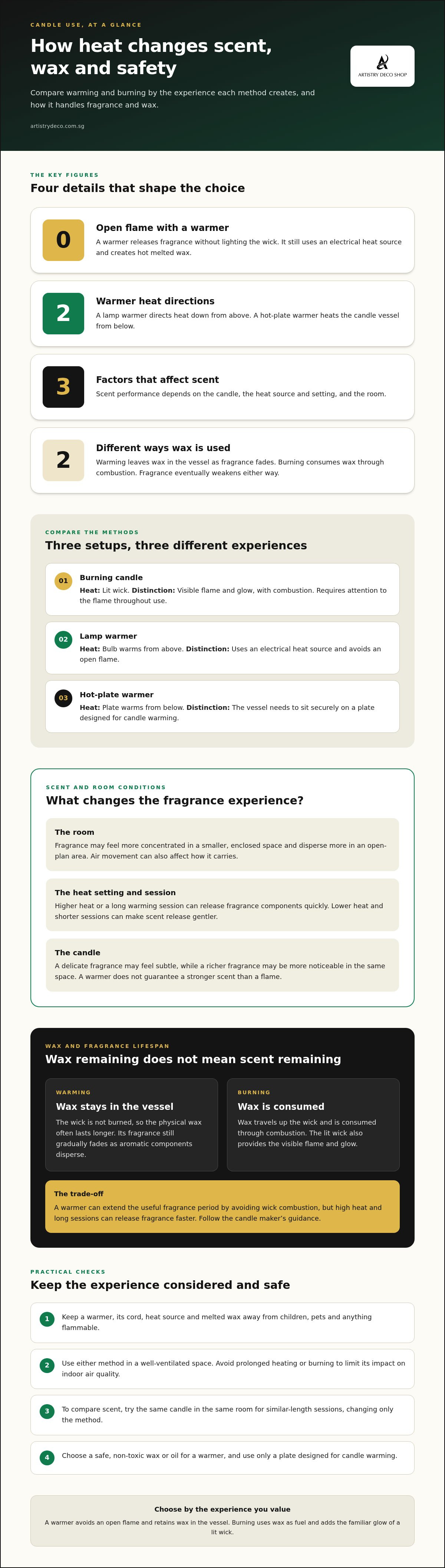
Candle warmer and burning comparison
A candle warmer uses electricity to heat wax, while a burning candle consumes wax through combustion. Candle size, jar shape and wax type affect compatibility, so the vessel must sit securely on a warmer designed for candle use.
Energy Use
Burning releases energy stored in a candle’s wax through combustion. A warmer draws electricity from a household outlet to heat the candle. Because these methods use different energy sources, the method alone does not establish which uses less energy overall. The comparison depends on the candle’s burn time and the warmer’s power use and operating time.
For a practical choice, consider the ritual as well as energy use. Burning provides a flame and consumes wax; warming keeps wax in its vessel while releasing fragrance. A short warming session and a brief burn are not equivalent measures unless you compare their duration and purpose.
Electricity Consumption
A candle warmer’s electricity consumption depends on its rated power and how long it runs. Without both details, you cannot calculate a precise figure. A warmer used for a short fragrance session draws power for less time than one left running longer, so switch it off after use to limit unnecessary operation.
Burning candles do not draw electricity from an outlet, but they consume wax as fuel. That does not make them energy-free. Compare the warmer’s power rating and actual runtime with your candle-use pattern rather than assuming either method is automatically more efficient.
Jar and wax compatibility also depend on the warmer’s design. A hot plate should be intended for candle warming, with the vessel sitting securely on its surface. Choose a suitable wax or oil, and use low-temperature melting wax with a warmer to reduce indoor-air impact.
- For a warmer: match the candle vessel to the heating surface and keep it stable.
- For burning: account for wax consumed during combustion, as well as the flame you prefer.
- For energy comparison: consider warmer power, operating time and candle burn time together.
Choose based on the candle’s fit, your preferred fragrance ritual and the warmer’s rated power.
Artistry Deco Shop: Functional Living Room Decor
Artistry Deco Shop offers functional living room decor to help shape a considered setting for everyday rituals. If a candle warmer or burning candle is part of your home atmosphere, thoughtfully chosen decor can give the surrounding space a cohesive focal point without changing how you use your candle.
Explore functional dining table centerpieces for a composed table, or modern artistic sculptures for a distinctive accent. World globes bring a decorative point of interest to a study or work desk. These pieces suit anyone who wants a room to feel personal as well as purposeful, with objects chosen for both presence and function.
Explore decor that complements your space at Artistry Deco Shop, artistrydeco.com.sg.
Choose the Ritual That Feels Right at Home
Deciding whether candle warmers are better than burning candles is also a choice about the atmosphere you want to create. Think about where you’ll enjoy the candle, how you want that corner of your home to feel, and whether the candle ritual should stand alone or sit within a broader decorative arrangement.
A considered setting can make the experience feel more personal. Give your candle an intentional place, then choose surrounding pieces to suit the room’s mood. The result need not be elaborate: a thoughtful focal point can bring quiet ceremony to an ordinary evening or a welcoming touch to a shared space.
If you’re refining your home’s character, explore a few pieces and let your taste lead. Small choices can make a room feel distinctly yours.
Make room for the details you love and enjoy creating a setting that feels genuinely your own.
Frequently Asked Questions
Which Gives a Stronger Scent?
Neither method always produces a stronger scent; the candle and room make a difference. For a useful home test, use the same candle in the same room and compare each method during similar sessions. Keep doors and windows in the same position, and note how noticeable the fragrance is from another part of the room. This helps you judge scent distribution, not just the fragrance near the candle.
Which Option Is Better for Your Home?
The better option depends on the atmosphere and routine you want at home. Choose burning if the visible flame is central to the experience. A warmer suits a preference for fragrance without an open flame, provided you can place and supervise the appliance safely. In a shared room, consider where people, pets, cords and nearby objects will be while the candle or warmer is in use.
Do candle warmers release fewer pollutants or reduce indoor air pollution compared with burning candles?
A warmer avoids combustion-related smoke and soot during normal use, but that does not mean it has no effect on indoor air. Heating wax releases fragrance components into the room, while burning also releases fragrance through combustion. Use either method in a well-ventilated space and for shorter periods. If indoor air quality is a priority, consider a natural beeswax or soy wax candle.
What are the fire and burn risks of candle warmers versus lit candles?
A lit candle has an open flame. A warmer removes that particular hazard but can still cause burns: a hot plate, bulb, vessel or melted wax can injure someone who touches it. Keep both methods away from flammable items. Place a warmer on a stable, heat-resistant surface, secure its vessel and keep cords clear of walking paths.
How long do candles last when used with a warmer compared with burning them?
A candle often retains its physical wax longer on a warmer because the wick is not consuming wax through combustion. However, fragrance fades as volatile components are released, even while wax remains visible. Burning consumes wax as it operates, and candles can burn for several hours before replacement. For a warmer, shorter sessions and lower heat can help pace fragrance release.
Are candle warmers safe to leave on, and what precautions should users take?
No. Do not leave a candle warmer unattended. Switch it off before leaving the room or going to sleep, and keep it on a stable, heat-resistant surface with clear space around it. Make sure the candle sits securely on a plate designed for candle warming or beneath the warmer’s bulb. Keep hot wax, the appliance and its cord away from children and pets.