
A History of Mantel Clocks for Singapore Collectors

A mantel clock began as a practical timekeeper and became a considered part of the home. Designed to sit on a mantel, shelf or similar flat surface, it grew into a distinctive form in France in the 1750s. The history of the mantel clock traces how craftsmanship, changing mechanisms and new ideas about domestic display shaped an object that could mark time while expressing its owner’s taste.
For Singapore collectors, understanding that story can make the details of an individual clock more meaningful. This article follows the mantel clock from its French origins through the evolution of winding mechanisms and wooden movements to the growth of American production. Along the way, it explores how a once-exclusive decorative object developed into a familiar household timepiece, and why its case, movement and design still reward a closer look.
Key Takeaways
- Learn how a clock’s case, materials and decorative details help distinguish its style and place it in the story of mantel clocks.
- Trace the form to 1750s France, where fireplace clocks became part of carefully composed domestic interiors.
- Understand how winding systems and the shift from wooden to brass movements changed how mantel clocks kept time.
- See how American factory production helped bring mantel clocks into more homes and shaped their changing designs.
What Is a Mantel Clock?
A mantel clock is made to stand on a fireplace mantel, shelf or similar flat surface, rather than hang on a wall. Antique examples are at least 100 years old, and their materials, mechanisms and decoration offer clues to their age and style.
Materials and Decorative Styles
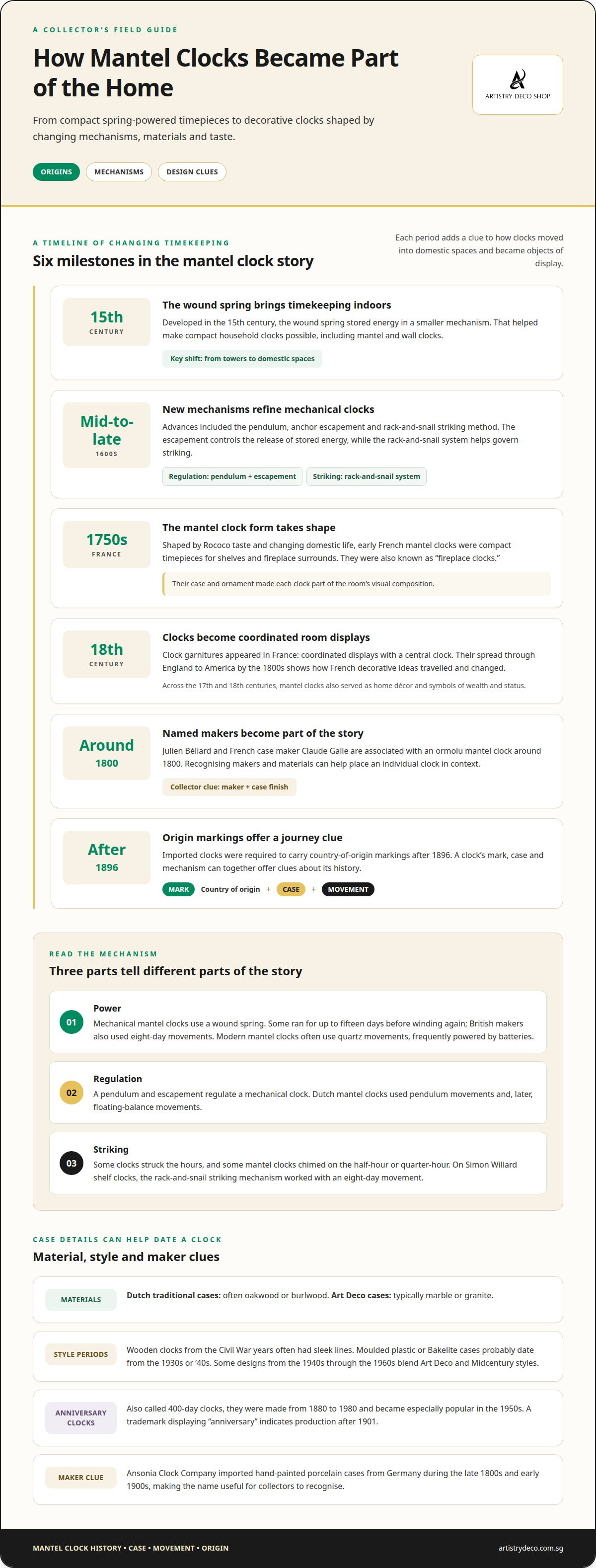
Case materials and ornament define a clock’s appearance and can help place it within a design period. Traditional Dutch mantel clocks were often made from oakwood or burlwood, while Art Deco period clocks typically used marble or granite. Wooden mantel clocks from the Civil War years often had sleek lines. Moulded plastic or Bakelite cases probably date from the 1930s or ’40s, while some designs from the 1940s through the 1960s blend Art Deco and Midcentury styles.
Anniversary clocks, also called 400-day clocks, were made from 1880 to 1980 and became especially popular in the 1950s. A trademark displaying “anniversary” indicates production after 1901. Ansonia Clock Company imported hand-painted porcelain cases from Germany during the late 1800s and early 1900s, making it a notable name for collectors to recognise. These details help distinguish a vintage decorative case from the mechanism inside it.
Clocks as Home Decor and Status
In the 17th and 18th centuries, mantel clocks became important home décor and symbols of wealth and status. Their position on a mantel made the clock part of a room’s display, where its case and finish could complement other furnishings. By the 18th and 19th centuries, mantel clocks were among the most popular clock forms. Across those periods, changing materials and ornament reflected shifting tastes in domestic interiors.
Julien Béliard and French case maker Claude Galle are notable makers associated with an ormolu mantel clock around 1800; Ansonia is another important manufacturer to know. For a modern comparison, wall, table and desk clocks show how a timepiece can still contribute to a room’s character. To maintain a mechanical antique, wind it regularly according to its maker’s instructions. Moving it while its pendulum is still hanging inside may harm the movement.
Origins of mantel clocks in France
The mantel clock form emerged in France in the 1750s, shaped by Rococo taste and changing domestic life. Its route from French interiors to other markets helps collectors place individual designs within a wider story.
Early French Shelf Clocks
Early French mantel clocks were compact timepieces designed for shelves and fireplace surrounds, rather than tall public spaces. During the Rococo period, they were known as “fireplace clocks.” The name reflects their intended setting, while each clock’s case and ornament made it part of the room’s visual composition.
Clock garnitures, coordinated displays that included a central clock, appeared in 18th-century France. Their spread through England to America by the 1800s shows how French decorative ideas travelled and changed. For collectors, a clock’s original setting and accompanying objects can help explain why its form feels more architectural or ornamental than a simple shelf clock.
Spring-Powered Household Clocks
The wound spring, developed in the 15th century, helped bring timekeeping from towers into homes. By storing energy in a smaller mechanism, it made more compact clocks possible, including mantel and wall forms. This shift matters because it connected clock design to domestic spaces, where size, display and daily use shaped the object.
Later, pendulums and improved escapements refined mechanical timekeeping. These developments shaped the mechanisms of household clocks, though a clock’s case style and movement construction tell different parts of its story. A bracket clock, by contrast, was designed to be portable and often had a handle on top.
French mantel clocks influenced designs beyond France, spreading through England to America by the 1800s. For Singapore collectors, country-of-origin markings can help place an imported clock within that wider history: imported clocks were required to carry such markings after 1896. A clock’s mark, case and mechanism together offer useful clues about its journey. For a contemporary point of comparison, explore timepieces in a considered home setting.
Winding mechanisms and wooden clock movements
A mantel clock’s movement reveals how it measured time, struck the hour and received power. Changes in materials and regulation shaped its daily operation as well as its decorative case.
Winding and Power Sources
Spring-driven clocks stored energy in a wound spring, allowing timepieces to operate beyond public towers. Mechanical mantel clocks used a pendulum and escapement to regulate their movement, and some also struck the hours. Winding intervals varied by design: some examples ran for up to fifteen days before needing to be wound again. Modern mantel clocks often use quartz movements, frequently powered by batteries, rather than a wound spring.
The change was not simply a shift from spring power to electric clocks. Quartz technology transformed how many modern clocks keep time, while traditional mechanical pieces preserve the visible rhythm of gears and pendulums. British clockmakers also used eight-day movements, giving owners a longer interval between windings than a daily routine.
Pendulum and Floating-Balance Movements
A pendulum movement regulates time through the steady swing of a suspended weight. Dutch mantel clocks used pendulum movements and, later, floating-balance movements, giving collectors two distinct mechanical approaches to consider. Movement type matters because it affects a clock’s internal arrangement and operation, even when an ornate case reveals little about the mechanism.
Mid-to-late 1600s advances included the pendulum, anchor escapement and rack-and-snail striking method. The escapement controls the release of stored energy, while the rack-and-snail system helps govern striking. On Simon Willard shelf clocks, this striking mechanism worked with an eight-day movement. Some mantel clocks also chimed on the half-hour or quarter-hour.
Wooden movements were generally used in mantel clocks made before 1820. Brass movements became popular in the mid-1800s, and by the early 1840s had nearly replaced wooden ones. Wooden movements began to be phased out in clockmaking in 1842; New Haven introduced brass movements in the United States after 1845. British Regency interiors, discussed in Thomas Hope’s 1807 book Household Furniture and Interior Decoration, provide a useful context for considering how a clock’s mechanism sat within its decorative case.
American mass production and affordable timekeeping
American makers transformed mantel clocks from costly objects into household timekeepers. Wooden movements and factory production helped make them more accessible, while new case styles kept pace with changing tastes.
In the early 1800s, Connecticut clockmaker Eli Terry began mass-producing mantel clocks. His 1816 shelf-clock patent helped transform American production, and water-powered machines supported the move towards factory work. By 1830, hundreds of Connecticut companies made clocks with wooden movements. Terry’s clocks were produced at a cost that brought accurate timekeeping within reach of middle-class American homes, a sharp contrast with earlier clocks as exclusive aristocratic objects.
Simon Willard also shaped the American shelf-clock market. He began selling standardised models in Boston in the 1790s, and his Massachusetts shelf clock was produced there around the first decades of the 19th century. These examples show how makers used repeatable designs and wooden mechanisms to serve more households. During the Victorian era, from 1837 to 1901, mantel clocks became common household items in England and America.
Victorian cases ranged from the ogee style, popularised by Seth Thomas before the Civil War, to later finishes such as Adamantine. Seth Thomas Adamantine mantel clocks were made from 1892 to 1917. In the 20th century, Art Deco brought streamlined forms to American mantel clocks during the 1930s. The style continued to shape designs through the 1940s and 1950s, in both Europe and America, while tambour clocks became popular in the early 20th century.
Prices varied across these periods: early clocks could be exclusive status objects, while factory-made wooden models made timekeeping more accessible. For collectors, maker names, movement materials and case styles show how production changed a clock’s place in the home.
Earlier mantel clocks were costly status objects, while factory-made wooden models became affordable for middle-class households.
Artistry Deco Shop: Unique & Playful Clocks
Artistry Deco Shop offers a contemporary way to bring a timepiece’s decorative presence into a Singapore home. If the history of mantel clocks has inspired you, but you’re seeking a fresh accent rather than an antique, explore its unique and playful clocks. They offer a distinctive direction for living room decor, with a timepiece serving as a point of interest within the space.
Consider how a clock’s shape and character will sit alongside the room’s existing pieces. For a composed display, pair it with functional living room decor or a modern artistic sculpture, giving each object a clear role. This is a natural next step if you see clocks as both useful and expressive, while antique collectors can continue to value original cases and movements on their own terms.
Contact Artistry Deco Shop to discuss a clock that suits your home.
Make Time for a Thoughtful Display
The history of the mantel clock can inform your choice of a timepiece for your home. Let its presence prompt you to consider scale, placement and the balance between practical objects and decorative pieces. In a Singapore living space, a clock can sit among objects that reflect your taste without requiring you to recreate a period interior.
Artistry Deco Shop offers Functional Living Room Decor, Functional Dining Table Centerpieces and Modern Artistic Sculptures. These pieces can create a considered setting around a distinctive clock, whether you’re arranging a living room display or adding character to a dining table. Choose items connected by form, material or mood, while giving each one room to stand out.
Contact Artistry Deco Shop to explore decor that feels right for your space.
A thoughtful display begins with what draws your eye. Let that guide you towards a home that feels distinctly yours.
Frequently Asked Questions
What materials and techniques were used to make historic mantel clocks?
Historic mantel clocks combined crafted cases with mechanical movements, and their materials can offer clues to construction and style. Cases included wood, hand-painted porcelain, marble, granite, moulded plastic and Bakelite. Some clocks used electroplating, a finish that places their manufacture after 1836. Compare the case finish with the visible movement and dial: together, these features provide a fuller picture than any single decorative detail.
How can you identify and date an antique mantel clock?
An antique mantel clock is at least 100 years old, but no single feature establishes its exact age. Use several clues together: imported clocks carry country-of-origin markings after 1896, while an “anniversary” trademark indicates production after 1901. Electroplating points to a date after 1836, and moulded plastic or Bakelite cases probably date from the 1930s or ’40s. Treat these as dating clues, then compare the case and movement.