
What is a Maquette in Sculpture? A Guide for Art Lovers

What if the most famous statues in history were actually born as tiny, palm-sized experiments? Many art lovers feel a bit lost when they hear experts talk about the secret stages of creation. You might wonder, what is a maquette in sculpture, and does a small model really count as a finished piece of art? It's easy to feel overwhelmed by technical jargon or to struggle with imagining how a giant brass monument starts its life.
You aren't alone in wanting to understand the magic that happens behind the scenes. It's natural to feel that a small model is just a draft, but these pieces are often the most personal works an artist ever creates. In this guide, you'll discover the fascinating role of maquettes in art and how these small-scale models shape the world’s most iconic sculptures. We'll look at the materials used in these models, why they're so valuable to collectors in 2026, and how they bridge the gap between a simple idea and a museum-quality masterpiece.
Key Takeaways
- Learn exactly what is a maquette in sculpture and why these small-scale models are essential for planning even the most massive monuments.
- Explore the tactile world of wax, clay, and plaster used to capture an artist's first creative spark before it becomes a final bronze or marble piece.
- Understand how these models serve as a vital blueprint to solve structural problems and win over clients before the expensive work begins.
- Trace the artistic journey from the Italian "bozzetto" to modern masterpieces, seeing how legendary sculptors like Bernini valued their small sketches.
- Discover why collecting small-scale models is a growing trend for Singaporean homes, offering a sophisticated gallery feel for modern living room decor.
Understanding the Maquette: More Than Just a Small Model
When people ask what is a maquette in sculpture, they're often looking for the secret behind the world's most impressive monuments. Every grand statue you see in a public square or a fine gallery likely started as a humble, palm-sized object. The word itself comes from the French term for a scale model or a sketch. It serves as a vital 3D "rough draft" that allows a creator to play with light, shadow, and form before committing to a massive block of stone or a heavy pour of metal.
A maquette is the bridge between a thought and a physical masterpiece. It's the moment an artist's vision leaves the mind and enters the physical world. By working on this smaller scale, the sculptor can test their ideas without the massive expense or labor of a full-size work. It's a place for mistakes, discoveries, and the raw energy of creation.
The Difference Between a Maquette and a Model
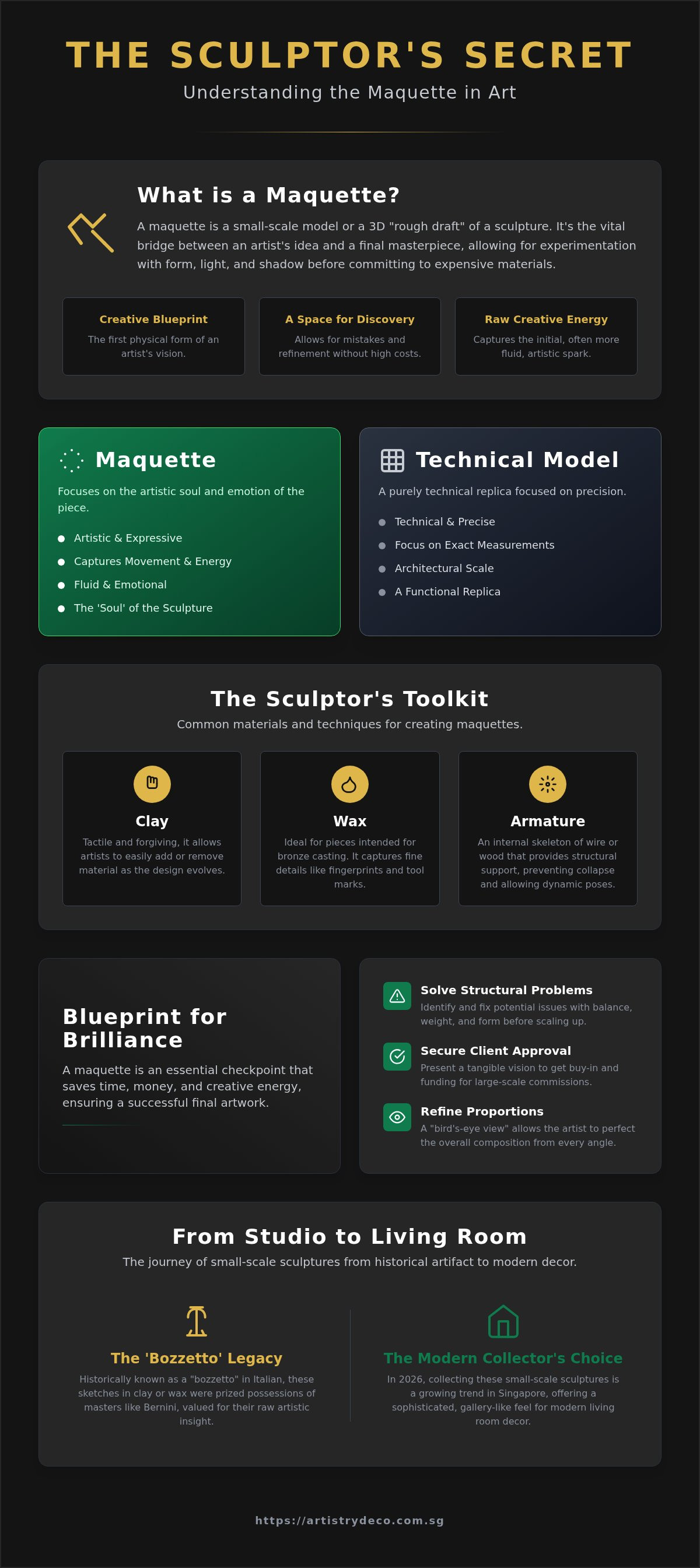
While people often use the words interchangeably, there's a subtle but important distinction. All maquettes are models, but not every model is a maquette. A standard model might be a purely technical replica, focused on exact measurements or architectural scale. In contrast, a Maquette is deeply artistic. It focuses on the "soul" and the movement of the piece. It captures the energy of the first creative spark, often appearing more fluid and emotional than the final, polished version. Understanding what is a maquette in sculpture means recognizing this raw, expressive quality that technical models often lack.
Why Scale Matters in the Sculpting Process
Scale is a powerful tool in any artist's studio. Working on a small scale lets a sculptor see the entire piece at once, which is nearly impossible when carving a ten-foot-tall figure. This bird's-eye view is essential for planning monumental public works. It helps the artist ensure the proportions look right from every angle. In 2026, we're seeing a shift where many collectors in Singapore prefer these intimate, smaller versions for their homes. A compact piece from The Aura Brass Sculpture Collection offers that same sense of expert craftsmanship but in a size that fits perfectly on a study desk or a curated shelf.
How Sculptors Create Maquettes: Materials and Techniques
The process of bringing a vision to life starts with selecting the right medium. Sculptors look for materials that are forgiving and easy to change. When exploring what is a maquette in sculpture, you'll find that the goal isn't permanence; it's flexibility. Artists need to be able to add a bit here or carve away a bit there without much effort. This early stage is all about exploration rather than the rigid durability of a finished statue.
Historically, the most common choices have been wax, clay, and soft plaster. These materials allow for a quick response to a sudden idea. If an artist wants to change the pose of a figure, they can do so in minutes. This speed is vital during the early stages of design. The material chosen often reflects the final goal. For instance, an artist planning modern artistic sculptures might start with a digital model, while a traditionalist sticks to earth-based media.
Working with Clay and Wax
Clay is perhaps the most popular choice for these small drafts. It is incredibly tactile and stays moist long enough for the artist to refine the details. It allows for an additive or subtractive process, meaning you can pull pieces off or stick more on as the design evolves. Wax is another classic choice, especially for pieces meant to become brass bronze statues. Because wax melts easily, it's perfect for the lost-wax casting process. It captures tiny textures, like fingerprints or tool marks, which give the final piece a sense of history and a human touch.
The Role of the Armature
Even a small model needs a backbone. This is where the armature comes in. Think of it as a skeleton made of wire or wood that sits inside the clay. Without this inner frame, a tall or thin sculpture would simply collapse under its own weight. A strong armature gives the sculptor the freedom to create dynamic poses. It supports the heavy material and ensures the model stays stable while the artist works. Even in small-scale models, a solid structure is the key to a successful design.
In 2026, technology has added a new layer to this craft. Digital maquettes created through 3D printing allow for perfect symmetry and easy scaling. Whether digital or handmade, the essence of what is a maquette in sculpture remains the same: it's about testing the limits of an idea. If you're curious about how these techniques apply to a custom piece for your home, you might want to chat with a specialist about the process.
Why the Maquette is Essential in the Sculpting Process
Creating a large-scale statue is a massive investment of time, money, and physical effort. When you ask what is a maquette in sculpture, you're really asking about the artist's insurance policy. It's much easier to fix a limb that looks slightly out of place on a twelve-inch model than it is on a three-ton stone carving. A maquette is the ultimate proof of concept for any major art project. It proves that the idea works in the physical world before the first expensive block of marble is even ordered.
Scaling up from these small drafts is a precise mathematical process that requires a sharp eye and a steady hand. Artists often use a grid system or a tool called a pointing machine to translate the measurements of the small model to the final masterpiece. Every curve and angle must be mapped out carefully. This ensures that the emotion and energy captured in the small version aren't lost when the piece grows to a monumental size.
Testing Balance and Composition
Gravity is a sculptor's greatest critic. A maquette lets the artist see if a statue will actually stand on its own without needing ugly external supports. By holding the model in their hands, they can check the flow and lines from every single angle. They look for how light hits the surface and how the shadows fall across the form. It's about ensuring the piece feels balanced and "right" whether you're standing directly in front of it or viewing it from the side. If the composition feels heavy or awkward, now is the time to change it.
Gaining Approval and Funding
In the professional art world, maquettes are the key to winning big commissions. When a city or a private donor wants a new monument, they don't just take the artist's word for it. They want to see it. This is where the "presentation maquette" comes in. Unlike the rough working models, these are highly polished and detailed. They help buyers visualize the final impact on a space. For anyone curious about what is a maquette in sculpture, the answer often lies in these high-stakes meetings where funding might be on the line. These models act as a silent salesman, showing the beauty of the proposed work in a way that a flat drawing never could.
From Bozzetto to Masterpiece: A Brief History
While the word we use today is French, the soul of this practice is deeply Italian. During the Renaissance, artists used the term "bozzetto" to describe a rough sketch made in clay, wax, or wood. Understanding what is a maquette in sculpture requires looking back at these early drafts. They weren't just discarded leftovers. They were the essential first steps for some of the world's most famous monuments. For those who appreciate how these traditions influence modern style, exploring our guide on vintage historical artifacts provides a deeper look at how we curate history in our homes today.
Masters like Michelangelo and Gian Lorenzo Bernini were famous for their extensive use of small models. Bernini, in particular, would create dozens of terracotta bozzetti to work out the complex movement of his figures. These small pieces allowed him to capture the tension of a muscle or the flow of a robe before he ever touched a chisel to stone. Today, these "sketches" are celebrated for their raw, unedited beauty. They offer a direct window into the mind of a genius at work.
The Renaissance Approach to Planning
Old masters didn't just use small models for size. They used them to study the play of light and shadow in three dimensions. By moving a candle around a small clay figure, they could predict how a giant marble statue would look in a sunlit cathedral. This transition from a quick sketch to a finished masterpiece was a long, thoughtful journey. Interestingly, many art historians find these historical models more expressive than the final statues. The small models contain the artist's first, most passionate thoughts, free from the constraints of large-scale engineering.
Maquettes as Museum Highlights
Walk through the halls of the Tate in London or the Louvre in Paris, and you'll find maquettes displayed with the same reverence as finished works. Museums value these pieces because they tell the story of the creative process. There's something incredibly moving about seeing an artist's fingerprints preserved in the original clay from centuries ago. It makes the legend feel human. These pieces aren't just tools; they are the purest record of an artistic journey. When you understand what is a maquette in sculpture, you begin to see every great statue as the end of a long, fascinating conversation between the artist and their materials.
Collecting Small-Scale Sculptures for Your Modern Singapore Home
In 2026, art lovers in Singapore are looking for more than just mass-produced items. They want pieces with a story and a soul. This is where understanding what is a maquette in sculpture becomes a lifestyle asset. These models bring a sophisticated gallery feel to any room, turning a simple shelf into a curated exhibition. They fit perfectly into the modern ethos of functional living room decor, where every object serves both a purpose and a deep artistic passion.
Singapore's urban living often means space is at a premium. You don't need a massive foyer to showcase high-end art. A well-placed maquette-style sculpture captures the same prestige as a full-sized statue but on a scale that respects your floor plan. These pieces act as magnetic conversation starters. When guests ask about the work, you can share the narrative of its creation, from the first clay model to the final bronze or marble masterpiece.
Styling Maquettes on Desks and Shelves
Creating a curated look requires a balance of form and function. Pair your small statues with unique world globes for desks to create a workspace that feels both global and artistic. Use soft, focused lighting to catch the textures of the bronze or stone. This highlights the maker's fingerprint, adding a human touch to a digital age. You can create a collector’s corner by mixing materials; place a smooth marble piece next to a rugged brass model to show the beautiful diversity of the sculpting process.
Why Small Art Makes a Big Statement
Small-scale art offers an intimacy that giant monuments can't match. You can pick it up, feel its weight, and see the details up close without any distance. Choosing a piece from the stone atelier collection ensures your home features a one-of-a-kind carving with its own unique history and texture. By focusing on what is a maquette in sculpture, you're investing in the very soul of the artistic process. A maquette-style piece adds a layer of intellectual luxury to your study or library. It shows you value the process of creation as much as the finished result. It's about surrounding yourself with the raw energy of a first idea, brought to life in premium materials that stand the test of time.
Bringing Artistic Vision into Your Daily Life
You've seen how a tiny model can hold the entire weight of a masterpiece. Understanding what is a maquette in sculpture changes how you look at every statue, whether it's a massive monument or a delicate piece on your shelf. These small-scale works aren't just steps in a process; they are the purest expression of an artist's first spark. By choosing these intimate forms, you bring a sense of intellectual luxury and museum-quality history into your home. It's about surrounding yourself with the raw energy of creation.
Artistry Deco Shop specializes in these expertly crafted narratives. Our curated selection of premium brass, bronze, and stone pieces offers more than just decoration. They are functional decor designed specifically for the elegant Singapore home. Each one-of-a-kind collectible invites you to celebrate the craft and the unique story behind its creation, where the cold strength of bronze meets the tactile history of a sculptor's hand. These pieces serve as a bridge between great artistic traditions and your own personal sanctuary.
It's time to transform your study or living room into a private gallery that reflects your refined taste and passion for the arts.
Frequently Asked Questions
Is a maquette considered a finished work of art?
Yes, a maquette is often considered a finished work of art in its own right. While it begins as a preliminary sketch, the raw energy and visible textures make it a unique collectible. Many museums and private collectors prize these small models because they capture the artist's first creative impulse. They aren't just tools; they're intimate expressions of genius that offer a direct connection to the sculptor's hands and mind.
What is the typical size of a sculpture maquette?
There isn't one fixed size, but most maquettes are small enough to be held in one hand. Typically, they range from 15 to 30 centimeters in height. This scale allows the sculptor to view the entire composition from every angle at once. Working small makes it easier to test proportions and balance before scaling up. For collectors, this compact size makes them the perfect artistic accessory for a study desk or a library shelf.
Can I buy a maquette instead of a full-size sculpture?
Yes, purchasing a maquette is an excellent way to own a piece of a larger artistic narrative. These small-scale models are particularly popular for Singaporean homes where space is limited. When you ask what is a maquette in sculpture, you're looking at a piece that holds the same prestige as a monument but fits elegantly on a side table. They offer a sophisticated gallery feel without requiring the vast floor space of a full-size statue.
What materials are best for making a maquette at home?
If you're experimenting at home, oil-based clay and wax are the best materials to use. Unlike water-based clay, oil-based options don't dry out, giving you unlimited time to refine your shapes. Wax is another traditional choice that allows for very fine detail. Both materials are forgiving and easy to manipulate. You can also use a simple wire armature to provide an internal skeleton, ensuring your small model remains stable as you build your design.
What is the difference between a maquette and a prototype?
The main difference lies in intent and expression. A prototype is usually a technical model used to test how a product works or fits together in a functional sense. A maquette is deeply artistic and focuses on the soul and movement of a sculpture. It isn't just about measurements; it's about capturing light, shadow, and emotion. While a prototype seeks mechanical perfection, a maquette seeks to preserve the energy of the artist's first creative vision.
Why are some maquettes more expensive than larger statues?
Price is often driven by rarity and the direct involvement of the artist. Many large statues are finished by assistants or foundries, but a maquette is usually handled entirely by the master sculptor. These pieces often carry the original fingerprints and tool marks of the creator, making them highly personal. In the world of fine art, this direct connection to the artist's hand can make a small, rare model more valuable than a mass-produced larger version.
How do I clean a small-scale brass or bronze sculpture in Singapore?
Cleaning a premium brass or bronze piece in Singapore's humid climate requires a gentle touch. Use a dry, soft microfiber cloth to remove dust every week. Avoid using harsh household chemicals or abrasive polishes, as these can damage the protective patina. If the piece needs a deeper clean, a tiny amount of distilled water on a cloth is usually enough. Always dry it immediately to prevent spotting. This simple care preserves the noble character of your artistic collectibles.
Do artists always make a maquette before starting a project?
Most professional sculptors use these models, but it isn't a universal rule. For large public commissions, understanding what is a maquette in sculpture is vital because clients usually require a visual model before approving funds. However, some contemporary artists prefer the challenge of working directly on the final material. While the maquette is a traditional and highly effective planning tool, the creative process remains a personal choice that varies from one master to the next.