
Sculpture Edition Numbers: A Guide for Collectors

What if the difference between a simple home accessory and a timeless legacy piece is hidden in a single fraction? When you come across a stunning marble or bronze work, seeing a mark like "1 of 10" can feel more like a riddle than a label. You aren't just looking for decor; you want to own a story that holds its value. Understanding sculpture edition numbers (e.g., 1 of 10) is the first step toward mastering the art of curation. It's the secret language that separates a rare treasure from a common object.
It's completely normal to feel a bit of hesitation when faced with art world jargon. You want to be sure that the piece you bring into your home is truly special and not just a mass-produced item in disguise. We promise to help you decode these numbers so you can build a sophisticated collection with absolute pride. This guide will walk you through the differences between limited and open editions. We'll also explore how to verify authenticity and what terms like Artist Proof really mean for your investment. By the end, you'll have the expert knowledge needed to select high-quality collectibles that reflect your refined taste.
Key Takeaways
- Master the skill of understanding sculpture edition numbers (e.g., 1 of 10) to ensure you're investing in a true collectible rather than a mass-produced item.
- Learn how the total edition size directly influences the rarity and long-term value of the modern artistic sculptures in your home.
- Discover the specific markings used for brass bronze statues and marble pieces to help you verify authenticity with confidence.
- Follow a simple guide to researching artists and inspecting physical stamps before making a high-end art purchase.
- Understand why one-of-a-kind sculptures offer a different level of prestige and heritage compared to limited series.
What Are Sculpture Edition Numbers and Why Do They Matter?
An edition number is more than just a mark; it's the artist’s promise of rarity. When you see a small, engraved set of digits on the base of a bronze or marble piece, you're looking at its unique identity. This mark tells you exactly how many copies of that specific design exist in the world. For any serious collector, understanding sculpture edition numbers (e.g., 1 of 10) is essential to distinguishing a curated masterpiece from a common object.
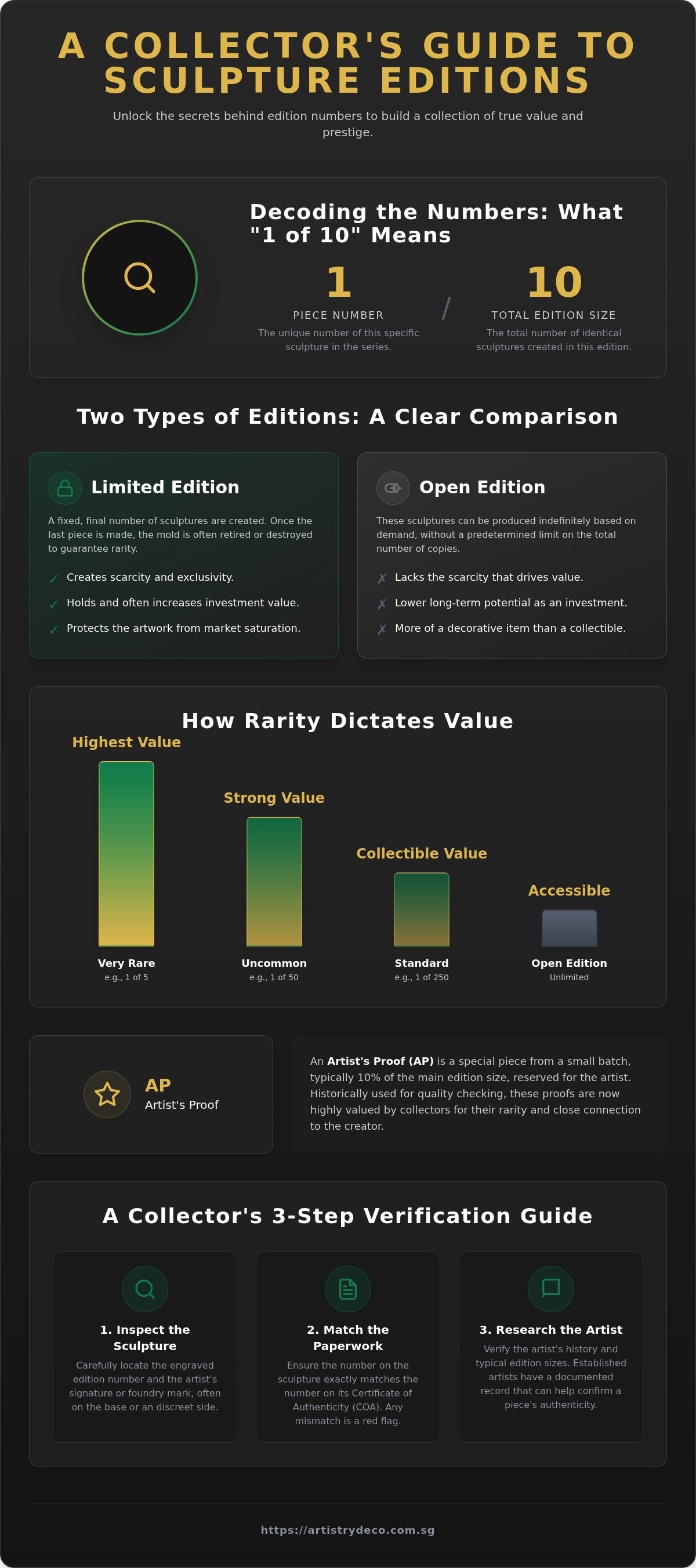
The notation usually follows a simple fraction format, such as 1/10 or 1 of 10. The first number represents the specific piece in your hands, while the second number indicates the total edition size. This system creates what historians call an artist's multiple, allowing more than one person to own a piece of a creator's vision without diluting its prestige. Limited editions bridge the gap between one-of-a-kind museum pieces and mass-produced home accessories, offering a perfect balance of value and accessibility.
The Difference Between Limited and Open Editions
A limited edition has a fixed, final number of pieces. Once the tenth sculpture in a series of ten is cast, the mold is often destroyed or retired. This finality creates a clear ceiling on supply, which is why collectors in Singapore often seek out limited runs for their brass bronze statues and living room decor. It ensures that your investment remains exclusive and protected from market saturation.
Open editions, by contrast, can be produced indefinitely. While they still carry the artist's aesthetic, they lack the scarcity that drives long-term value. For those looking to build a sophisticated home gallery, the fixed nature of a limited series provides a sense of security and heritage that open editions simply cannot match. It's the difference between owning a piece of history and owning a retail product.
The Concept of Functional Art in Editioning
Functional art is the intersection of beauty and daily use, where a sculpture serves a purpose beyond its visual appeal. In the world of high-end curation, even utilitarian items like unique and playful clocks or designer vessels can be part of a numbered series. When a clock is marked as a limited edition, it transforms from a simple timekeeper into a collectible asset. This combination of utility and prestige is a growing trend among those who want their homes to feel both lived-in and expertly curated. Owning a numbered piece of functional art means your everyday environment is built on a foundation of rarity and intentional design.
Decoding the Markings: Understanding Sculpture Edition Numbers (e.g., 1 of 10)
When you look closely at a limited edition piece, you'll usually find two numbers separated by a slash or the word "of". This fraction is the most common way to mark a series. For anyone interested in understanding sculpture edition numbers (e.g., 1 of 10), the logic is straightforward. The top number is the unique ID of that specific piece, while the bottom number represents the total quantity produced. According to Tate's definition of an art edition, this number ensures that only a set amount of the artwork will ever exist. A smaller total size, like 1 of 5, often leads to higher market value because of its extreme rarity.
These markings aren't always obvious. Artists often hide them on the base, the underside, or even the back of a sculpture to keep the visual flow clean. Once you find the number, it's vital to check your paperwork. Every high-end collectible should come with a Certificate of Authenticity (COA). This document must match the number on the sculpture exactly. If the numbers don't align, the piece's history and value could be in question. If you're unsure about a piece you've found, you can always reach out to our curators for guidance on what to look for.
What Does "AP" and "HC" Mean on a Sculpture?
Sometimes, you won't see a fraction at all. Instead, you might see "AP" or "HC". AP stands for Artist Proof. Historically, these were the first few casts the artist kept to check the quality of the mold. Today, they're usually a small batch, often around 10% of the main edition, that the artist keeps for personal use or exhibition. HC stands for Hors Commerce, which means "out of commerce". These were originally gifts for dealers or friends. Because these pieces were never meant for public sale, they can sometimes be more valuable than the standard numbered series due to their "insider" status.
Is Number 1 of 10 More Valuable Than 10 of 10?
Many new collectors wonder if being "the first" makes a piece worth more. In modern casting for marble or stone statues, the technology is so precise that the quality is identical from the first to the last. While traditional collectors might pay a small premium for number 1, the market generally treats all numbers in an edition as equal. The total edition size is a much bigger deal. A piece from an edition of 5 is almost always more valuable than number 1 from an edition of 500. Rarity is the true driver of price, not the sequence.
How Edition Numbers Impact the Value of Modern Artistic Sculptures
Rarity is the engine that drives the high-end art market. When collectors focus on understanding sculpture edition numbers (e.g., 1 of 10), they're looking at more than just a sequence. They're evaluating how a limited supply will meet future demand. In the Singapore luxury sector, 2026 trends show a strong shift toward physical, textured pieces that offer a tactile experience. This makes a physical "proof of rarity" even more vital for modern artistic sculptures. Collectors want to know that their investment is protected by a finite production run that cannot be expanded later.
Editioning for Different Materials: Brass, Bronze, and Stone
The material used in a piece often dictates its editioning strategy. Bronze and brass are typically cast from molds. Because the casting process involves intense heat and pressure, these molds eventually wear out. This technical reality naturally supports a limited series. For example, The Aura Brass Sculpture Collection offers premium numbered pieces where the count reflects this technical boundary. Marble and stone are quite different. Every block of stone has its own unique veining and spirit. Since these are carved by hand rather than cast, they're frequently one-of-a-kind treasures. This guide to buying limited edition sculptures explains how these material choices impact the markings you'll find on the base.
The Long-Term Value of Numbered Collectibles
A clear edition number is a collector's best friend during insurance appraisals or future resale. It creates a verifiable link to the artist's original intent and the work's provenance. Beyond the financial benefits, there's a unique joy in owning a "limited" piece of history. It creates a sense of belonging to an exclusive circle of like-minded connoisseurs who appreciate fine craftsmanship. While a series of ten is highly prestigious, "1 of 1" or one-of-a-kind sculptures stay at the very top of the hierarchy. These pieces represent a singular, unrepeatable vision. They're the ultimate choice for those who value absolute uniqueness in their home gallery.
A Collector’s Guide to Buying Limited Edition Sculptures in Singapore
Entering the Singapore art market is an exciting journey for any homeowner. Whether you're visiting a gallery in Orchard or browsing a curated online boutique, you need a clear plan to ensure your purchase is a sound investment. When you're physically inspecting a piece, understanding sculpture edition numbers (e.g., 1 of 10) becomes your most practical tool. It allows you to verify the rarity of the work right there on the spot.
To build a collection with confidence, follow these essential steps:
- Research the artist: Look into their history and the total number of editions they usually produce. Consistency is a sign of a professional.
- Inspect the piece: Look for a clear, stamped, or engraved edition number. It should be crisp and legible, not an afterthought.
- Verify the material: High-grade materials like bronze or heavy brass have a specific weight and cool touch that mass-produced resin lacks.
- Demand the COA: Never complete a high-end purchase without a Certificate of Authenticity that matches the piece's number.
- Plan the display: A limited edition piece is a conversation starter. It deserves a prominent spot in your living room where the light can highlight its form.
Spotting Authentic Markings on Petrified Wood and Stone
Natural materials like petrified wood or solid marble offer a different kind of prestige. These pieces often cannot be editioned in the traditional sense because the material itself is millions of years old and impossible to replicate. In these cases, "one-of-a-kind" status replaces the standard fraction. When you explore a Fossil and Petrified Wood Collection, you're looking for natural beauty rather than a stamped number. The value here lies in the fact that no two fossilized shells or stone carvings will ever be identical.
Building a Cohesive Collection in Your Singapore Home
A sophisticated home gallery often mixes different mediums to create visual depth. You might pair a numbered brass statue with a one-of-a-kind petrified wood centerpiece. To make the space feel intentional, you can use functional decor like world globes or unique clocks to bridge the gap between your art and your daily life. Learning how to style functional living room decor helps you place these items so they complement your sculptures rather than cluttering the room. This curated approach turns a house into a personal museum.
Why Curated Limited Editions are the Future of Home Decor
The modern home is evolving into a personal sanctuary of meaning. We're seeing a clear departure from the era of mass-produced, soul-less items that lack a narrative. Instead, collectors are choosing objects that carry a sense of heritage and permanence. This is where understanding sculpture edition numbers (e.g., 1 of 10) becomes a vital skill for the discerning homeowner. It transforms the act of shopping into an act of curation. By selecting a numbered piece, you're ensuring that your space reflects a level of rarity that can't be found in a standard retail store. This shift toward limited runs ensures that your interior design remains as unique as your own personal story.
Choosing limited editions is also a powerful way to support physical craftsmanship. In a world increasingly saturated with digital and AI-generated imagery, the value of something human-made has never been higher. A limited run allows an artist to focus on the fine details of a small batch, ensuring that each piece meets a high standard of quality. When you invest in an editioned sculpture, you're becoming part of that artist's legacy. You're a patron of the arts, not just a consumer. This connection adds a layer of emotional value to your home that no mass-market item could ever provide. It's an investment in a future where quality and intentionality are the primary markers of luxury.
Exclusivity Meets Daily Living
You don't need to live in a museum to enjoy the prestige of a numbered collection. Functional living room decor is often the most approachable entry point for new collectors. Bringing art into your daily life through items like a unique and playful clock or a designer vessel makes the exclusive feel accessible. There is a quiet joy in knowing that the functional object you use every day is part of a limited world. For those seeking the ultimate level of rarity, The Stone Atelier Collection offers carvings that are entirely one-of-a-kind, merging ancient materials with modern vision. These pieces don't just sit on a shelf; they interact with your environment, changing the energy of a room through their physical presence and historical weight.
Start Your Collection with Artistry Deco Shop
Our commitment to sourcing unique and limited edition art for Singapore is rooted in a passion for discovery. We believe that a home should be a collection of stories, not just a set of furniture. At Artistry Deco Shop, our curators are here to help you navigate the nuances of numbering and materials, ensuring you feel confident in every addition to your gallery. We invite you to visit our space and feel the tactile beauty of our brass and stone pieces for yourself. Seeing the light catch the patina of a numbered bronze or the unique grain of petrified wood is an experience that no photograph can fully capture. It's time to build a home that is as unique as you are, filled with pieces that will stand the test of time and trends.
Elevate Your Home with a Curated Art Collection
Mastering the art of curation starts with a single step: understanding sculpture edition numbers (e.g., 1 of 10). This knowledge empowers you to look past the surface and recognize the true rarity of a piece. You've seen how limited runs protect your investment and how special markings like AP or HC add layers of story to your collection. Whether it's a numbered bronze statue or a unique stone carving, these pieces bring a sense of heritage into your daily life. It's about surrounding yourself with objects that have a soul.
As a Singapore-based curated gallery, we're specialists in rare brass and petrified wood sculptures. We're dedicated to helping you select high-end functional art for modern interiors that reflects your personal style. Building a legacy collection takes time, but the reward of living among beautiful, meaningful objects is worth every moment of research. We're here to guide you through the process of finding that perfect, numbered treasure.
Your journey into the world of fine art is just beginning. We look forward to helping you discover pieces that will inspire you for years to come.
Frequently Asked Questions
What does 1 of 10 mean on a sculpture?
"1 of 10" identifies your specific piece as the first in a strictly limited series of ten. The first number is the sequence ID, and the second is the total quantity produced. This is a core part of understanding sculpture edition numbers (e.g., 1 of 10) because it provides a clear record of rarity. It ensures that your piece belongs to an exclusive group, making it a true collectible rather than a mass-market item.
Is an Artist Proof (AP) more valuable than a numbered edition?
An Artist Proof can be more valuable because they're part of a much smaller batch, often just 10% of the total edition size. Historically, these were the personal copies kept by the creator for quality control or exhibition. Collectors often prize them for their insider status. While the physical quality matches the numbered series, the added rarity often commands a premium price in the secondary art market.
How do I know if a sculpture edition is actually limited?
You can verify a limited edition by checking for a physical stamp on the piece and matching it to a Certificate of Authenticity. A reputable gallery will provide this document, which lists the artist's name, the title of the work, and the total edition size. If a piece is an open edition, it won't have these specific fractional markings. Always research the artist's history to ensure they respect their production limits.
Do all sculptures have edition numbers?
No, only sculptures produced in multiples, like cast bronze or brass, typically use edition numbers. One-of-a-kind pieces carved from stone, marble, or petrified wood don't need them because they're inherently unique. These singular works are often signed by the artist but won't feature a fraction. Mass-produced decor found in big-box stores also lacks these numbers, as they're made in unlimited quantities without artisanal oversight.
What happens if a sculpture has no edition number?
If a cast piece lacks a number, it's often an open edition, meaning it can be produced indefinitely. This usually results in lower long-term value. However, don't confuse this with unique works. A hand-carved stone sculpture won't have a fraction because it's the only one in existence. Always ask the gallery for the edition status. If it's a cast piece without a number, it's likely intended as decor rather than a high-end collectible.
Can an artist make more sculptures after a limited edition is sold out?
Ethical artists never produce more copies once a limited edition sells out. Doing so would be a breach of trust with their collectors. To prevent this, molds are often destroyed or permanently marked as retired. Understanding sculpture edition numbers (e.g., 1 of 10) means you're buying into a fixed supply. This scarcity is what allows modern artistic sculptures to hold their value over time. It's a fundamental rule of the professional art market.
Why are some edition sizes so much larger than others?
Edition sizes vary based on the artist's vision and market strategy. A very small edition, like 5 or 10, is designed for extreme exclusivity and higher price points. Larger editions, such as 250 or 500, allow more collectors to own the work at a more accessible price. While both are limited, the smaller run will always be more prestigious. The artist decides this number before production begins to maintain the integrity and rarity of the series.
Where is the edition number usually located on a statue?
You'll typically find the edition number discreetly engraved or stamped on the base, the back, or the underside of the statue. Artists often place these markings in subtle locations so they don't interfere with the visual beauty of the work. On bronze pieces, the number is often cast near the artist's signature. If you can't see it immediately, check the lower rim of the sculpture or the very bottom where it rests on a pedestal.