
How to Tell if a Crystal is Real or Glass: The Complete 2026 Expert Guide

Have you ever held a piece of decor that looked perfect but felt strangely hollow? It's a common fear for many collectors who worry they might be overpaying for a simple replica. Learning how to tell if a crystal is real or glass is more than just a technical skill; it's an essential part of becoming a true connoisseur of fine materials. You deserve to know that the items in your home possess the weight and brilliance that only genuine craftsmanship can provide.
We understand that the world of high-end decor can feel overwhelming, especially when you're trying to distinguish between lead crystal, natural quartz, and standard glass. This guide promises to turn you into an expert curator by teaching you simple sensory tests you can perform right at home. We'll explore the musical ring of a fine rim, the way light dances through a prism, and the undeniable heft of quality materials. You'll also learn why the 24 percent lead oxide standard remains the hallmark of true luxury in 2026. By the end, you'll shop with total confidence and a deeper appreciation for the art of the find.
Key Takeaways
- Learn why mineral content creates a unique sparkle and high refractive index that standard glass cannot mimic.
- Master the weight and sound tests to instantly identify the heavy heft and musical ring of authentic lead crystal.
- Discover exactly how to tell if a crystal is real or glass by observing how light splits into a vibrant rainbow prism.
- Gain the skills to spot glass fakes in stone decor by using the Mohs scale to check for mineral hardness.
- Understand how investing in genuine materials like petrified wood elevates your living space with lasting beauty and value.
What is Crystal? Understanding the Difference Between Glass and Crystal
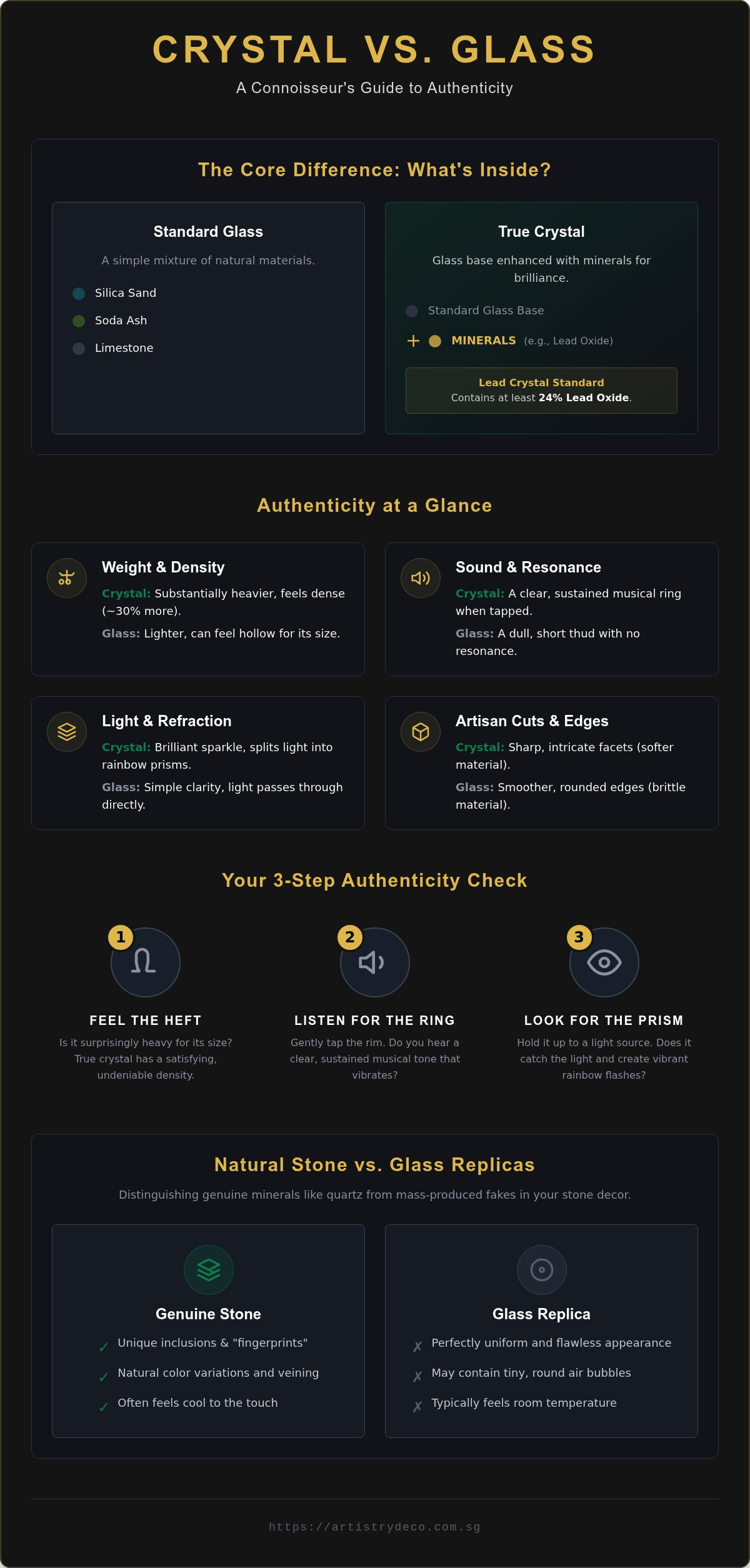
To the untrained eye, a sparkling decanter and a simple glass jar might look similar, but their souls are worlds apart. Crystal is not a separate material from glass; rather, it's an elevated, refined version of it. While standard glass consists of silica sand, soda ash, and limestone, crystal introduces specific minerals like lead oxide, zinc, or barium into the furnace. These additions are what create the majestic clarity and weight we associate with luxury. Understanding this chemical foundation is the first step in learning how to tell if a crystal is real or glass.
Glass serves as the practical, more affordable standard for mass production because it's durable and easy to manufacture in large quantities. However, it lacks the complex optical properties that define a masterpiece. True crystal acts as a prism, capturing and bending light in ways that simple soda-lime glass never could. This distinction is why a curated home feels different when it's filled with authentic materials instead of common replicas.
The Role of Lead in Fine Crystal
Lead is the traditional secret ingredient that transforms basic glass into a work of art. According to current standards, a piece must contain at least 24% lead oxide to be officially labeled as "lead crystal" in the European Union. This high mineral content significantly changes the physical nature of the object. Lead glass is much denser than standard glass, which explains that satisfying heft you feel when picking up a quality piece.
It's also a softer material. This might sound counterintuitive for a luxury item, but it's a vital feature for artisans. The relative softness of lead crystal allows master cutters to carve deep, intricate designs and sharp facets by hand. These cuts would cause standard glass to shatter or chip. While modern "lead-free" crystal uses minerals like barium or potassium to achieve a similar glow, the classic leaded variety remains the gold standard for those who value heritage and weight. These technical details aren't just for scientists; they're the keys to identifying quality at a glance.
Natural Crystals vs. Man-Made Glass
We must also distinguish between "crystal glass" and "natural crystals" like quartz or amethyst. While one is a refined man-made material, the other is a mineral formed deep within the earth over millions of years. When you're selecting pieces for a sophisticated interior, choosing marble & stone statues or fossilized accents offers a different type of authenticity.
Natural stones possess unique "fingerprints" such as tiny inclusions, color variations, or veining that mass-produced glass simply cannot replicate. Glass is uniform and predictable, often showing tiny air bubbles from the cooling process. In contrast, natural materials carry the weight of history and geological time. Knowing how to tell if a crystal is real or glass involves looking for these organic imperfections. A perfect, bubble-free surface often points to high-end crystal glass, while a piece of natural stone will always tell its own unique story through its texture and cool touch.
3 Simple Sensory Tests to Identify Real Crystal at Home
You don't need a degree in geology to understand how to tell if a crystal is real or glass; you simply need to trust your hands and ears. Authenticity has a specific weight and a unique voice. When you're curating a space with premium items, these sensory details become the dividing line between a common object and a true treasure. By engaging with your decor through touch and sound, you can quickly separate mass-produced items from handcrafted masterpieces.
The Ring Test: Listening for the Musical Tone
One of the most elegant ways to identify quality is through sound. Gently wet your finger and run it around the rim of the piece, or give it a very light tap with your fingernail. Real crystal will reward you with a clear, bell-like ring that sustains itself for several seconds. In contrast, common glass produces a dull, short thud that fades almost instantly. The ring test is a vibration caused by lead content. This musical resonance is a direct result of the mineral density we discussed earlier, giving the material a "voice" that glass simply cannot mimic.
Evaluating Weight and Density
Lead is a heavy metal, which makes lead crystal about 30% heavier than standard soda-lime glass of the same size. When you pick up an authentic piece, it should feel surprisingly substantial in your palm. This density is one reason why the material is favored for modern artistic sculptures, as the extra weight adds a premium feel and provides better stability on your shelving. If a large bowl or statue feels light or "plasticky," it's likely a glass replica. Comparing the item to a known glass object of a similar volume is the easiest way to feel the difference in gravity.
Temperature and thickness also offer vital clues. Natural minerals and lead-rich glass are excellent thermal conductors. If you refer to the Gem Encyclopedia, you'll see that many natural stones stay cool because they draw heat away from your skin quickly. Real crystal will feel noticeably colder to the touch than glass when first picked up. Furthermore, because crystal is stronger than glass due to its mineral structure, artisans can blow it into incredibly thin, delicate shapes. If a piece is paper-thin yet feels heavy and rings like a bell, you've found the real thing. Mastering these tests ensures you never have to guess how to tell if a crystal is real or glass when adding to your collection. If you ever feel uncertain about a rare find, you can always ask our curators for advice on material authenticity.
The Light Test: Using Prisms and Clarity to Spot Quality
Light reveals what the eyes might miss at first glance. While the weight and sound of a piece provide strong clues, the way an object interacts with a beam of sunlight is a definitive test. This visual inspection is a fast, reliable method for how to tell if a crystal is real or glass. Because crystal has a much higher refractive index than standard glass, it bends light with greater intensity. This creates a brilliance that feels alive, making the piece glow even in low-light settings.
The Rainbow Prism Test
To perform this test, hold your piece up to a direct light source or a patch of bright sunlight. Slowly rotate the object and watch how the light passes through the facets. If you see vivid, sharp rainbows dancing on nearby surfaces, you're likely holding high-quality crystal. Standard soda-lime glass lacks the mineral density required to split light into a full, colorful spectrum. Understanding the difference between crystal and glass comes down to this optical magic. Glass will simply let the light pass through or create a faint, colorless reflection without the prismatic fire of true lead crystal.
Another advanced visual trick involves a UV light or blacklight. Under this specific spectrum, real lead crystal often shows a soft blue or violet glow due to its chemical makeup. Most mass-produced glass will remain dull or show a muddy green tint under UV light. This simple tool can be a secret weapon for collectors who want to verify their finds with scientific accuracy.
Inspecting for Inclusions and Bubbles
Look deep into the material with a magnifying glass or under a bright lamp. Man-made glass often contains tiny, perfectly round air bubbles that get trapped during the cooling process. These are a sure sign of a cheaper, mass-produced item. Fine crystal is typically clear and free of these circular air pockets. However, if you are admiring marble & stone statues, the rules change slightly.
Natural minerals often feature "inclusions," which are small internal feathers, wisps, or color variations. These are not flaws but natural fingerprints that prove the stone came from the earth and not a factory mold. When learning how to tell if a crystal is real or glass, remember that glass is uniform and "perfectly" flawed with round bubbles. Natural stone and high-end crystal glass prioritize a level of clarity and organic texture that replicas can't reach. Cheap glass also tends to have a slight greenish or yellow tint at the edges, whereas premium crystal remains brilliantly colorless.
Real Gemstones vs. Glass Replicas: Spotting the Fakes in Decor
Distinguishing between earth-born minerals and factory-made glass is a skill every serious collector should master. While we've already covered the optical and auditory clues for crystal glass, natural gemstones and fossils follow a different set of rules. Knowing how to tell if a crystal is real or glass becomes even more vital when you're investing in large-scale stone decor. Authentic minerals carry a history that spans millions of years, and this heritage is visible in every vein and crack. These pieces aren't just objects; they're snapshots of geological time that bring a grounded, ancient energy to your home.
The Beauty of Natural Imperfection
Natural stone sculptures possess an organic rhythm that glass replicas can't match. When you examine petrified wood sculptures, you'll see intricate rings and textures that were once part of a living tree. These patterns are random and complex. If you notice a pattern that repeats perfectly or looks too symmetrical, it's a sign of a mass-produced resin or glass mold. No two natural pieces are exactly alike. This lack of uniformity is the ultimate mark of luxury. It tells you that your piece is the only one of its kind in the world, carrying "fingerprints" that no machine could ever replicate.
The Hardness Test
The Mohs scale of mineral hardness is a reliable scientific tool for your home toolkit. Most common glass sits at about a 5 or 5.5 on this scale. Many natural crystals, like quartz or agate, are much harder. This means they shouldn't be scratched by a simple steel blade or a piece of glass. While the scratch test is a famous way to figure out how to tell if a crystal is real or glass, you must be careful. We don't recommend scratching the visible surface of a fine piece, as this can lower its value and ruin the aesthetic harmony.
Instead of aggressive testing, look for natural growth lines or tiny inclusions. These internal features are almost impossible to fake with glass. For high-value items or vintage historical artifacts, a professional appraisal is always the safest route. Experts use specialized tools to confirm the material without causing any harm. Buying from a curated source ensures that every piece has been pre-vetted for its geological truth, saving you from the heartbreak of a clever imitation.
Choosing Authentic Decor: Why Quality Materials Elevate Your Living Space
Investing in the right materials is about more than just aesthetics; it's about the energy and longevity of your home environment. While standard glass might serve a basic purpose, it lacks the soul and enduring beauty of genuine minerals. Learning how to tell if a crystal is real or glass is the final step in moving from a casual shopper to a discerning collector. Quality materials don't just sit in a room; they transform it by interacting with natural light and providing a sense of permanence that mass-produced items cannot provide. These pieces become part of your home's narrative, growing more valuable as they are passed down through generations.
Authentic materials carry a specific optical fire that cheap replicas can't replicate. A handcrafted sculpture made from high-lead crystal or solid marble is built to withstand the test of time. Unlike standard glass, which can become cloudy or easily scratched with minimal use, premium materials maintain their brilliance and structural integrity. This enduring quality makes them true legacy pieces. When you choose authenticity, you're choosing a more luxurious atmosphere where every reflection and shadow feels like a deliberate part of a larger artistic vision.
Creating a Focal Point with Functional Art
A well-designed room often needs a singular, high-quality anchor to tie the space together. Whether it's a heavy stone centerpiece or a masterfully cut crystal vase, these objects invite both admiration and touch. There is a specific tactile pleasure in the cool surface of real marble or the substantial heft of a leaded glass rim. We encourage you to seek out "functional art" pieces that offer both utility and sculptural beauty. These items elevate daily rituals, turning simple tasks into moments of connection with the natural world. An authentic focal point doesn't just fill a gap; it commands the room through its material truth.
The Artistry Deco Shop Commitment to Authenticity
We understand that building a curated home requires trust in the materials you select. At Artistry Deco Shop, we handle the technical vetting process so you don't have to worry about the complexities of how to tell if a crystal is real or glass on your own. Every item in our collection is handpicked for its structural integrity, mineral purity, and historical narrative. We believe that owning something truly "real" creates an emotional bond that a factory-made replica can never forge. It provides a sense of peace and pride, knowing your surroundings are built on a foundation of genuine craftsmanship.
To see how these authentic materials can be integrated into your home, explore our guide on Functional Living Room Decor. Before you make your next acquisition, keep this expert checklist in mind to ensure your space is filled only with the finest materials:
- Weight: Does the piece feel significantly heavier than a standard glass object of the same size?
- Sound: Does it produce a long, musical ring when gently tapped with a fingernail?
- Prism: Does it split direct light into sharp, colorful rainbows on nearby surfaces?
- Source: Is the item coming from a specialized curator who values material history and rare origins?
Curating Your Collection with Confidence
You now possess the sensory tools to navigate the world of high-end decor with absolute certainty. By trusting the musical resonance of a fine rim and the substantial heft of mineral-rich materials, you've moved beyond the surface level of casual collecting. Mastering how to tell if a crystal is real or glass ensures that every piece in your home serves as a testament to genuine artistry and millions of years of geological history.
True luxury lies in the subtle details that replicas simply can't mimic. Whether it's the sharp rainbow prisms of leaded glass or the unique, organic inclusions found in natural stone, these features define a sophisticated interior. We remain dedicated to providing handpicked rare materials and expertly curated pieces for modern interiors. Every item we offer represents a one-of-a-kind handcrafted design that's been selected for its soul and its structure.
Your journey as a connoisseur is just beginning. We invite you to surround yourself with objects that resonate with truth and beauty, turning your living space into a personal gallery of authentic experiences.
Frequently Asked Questions
Can I tell if a crystal is real with a phone light?
Yes, your phone light is a perfect tool for a quick prism test. By shining the light through the material and watching the reflections on a white surface, you can spot the sharp rainbows that define high-quality crystal. Standard glass lacks the mineral density to create these vibrant colors. It's a simple way to start learning how to tell if a crystal is real or glass when you're out shopping.
Is lead crystal safe to use for drinking and dining?
Lead crystal is safe for serving food and drinks, but you shouldn't use it for long-term storage. While the lead is chemically bonded within the material, acidic liquids like wine or juice can cause leaching if left for days. For a beautiful dinner party, it's perfectly fine to use your finest stemware. Just remember to hand wash them with care to maintain their brilliance for years to come.
Why is my crystal turning yellow or cloudy over time?
Cloudiness is often caused by "glass sickness" or damage from harsh dishwasher detergents. Real lead crystal is more porous and sensitive to heat than common glass. This etching can ruin the clarity that makes the material so valuable. To prevent this, always hand wash your pieces in lukewarm water with a mild soap. This gentle ritual protects the surface and keeps the light dancing through the facets.
What is the easiest way to identify real quartz from glass?
The temperature test is the most reliable method for distinguishing natural quartz from man-made glass. Real quartz will feel icy cold to the touch because it draws heat away from your skin much faster than glass. You should also look for natural inclusions or internal "feathers." Glass often contains perfectly round air bubbles, while natural stones have unique, organic patterns that prove they were formed deep within the earth.
Do all real crystals have bubbles in them?
No, high-quality lead crystal should be almost entirely free of air bubbles. If you see small, perfectly round bubbles, you're likely looking at mass-produced glass. Natural stone crystals might have internal marks, but these are mineral inclusions rather than trapped air. Finding a piece with perfect clarity and no bubbles is a hallmark of expert craftsmanship and premium materials.
How can I tell if my vintage glass is actually valuable crystal?
The sound test is your best friend when evaluating vintage finds. Give the rim a gentle tap with your fingernail; a long, musical ring indicates valuable lead crystal. You should also look for acid-etched signatures or marks on the base. Since vintage pieces often carry a higher lead content, they will feel much heavier than modern glass replicas of the same size.
Does blacklight always make real crystal glow purple?
A blacklight often reveals a soft blue or violet glow in lead crystal, but it isn't a universal rule. This fluorescence happens because of the specific minerals and lead oxide used in the recipe. While it's a fun way to explore how to tell if a crystal is real or glass, you shouldn't rely on it alone. Combine this with the weight and sound tests for a more accurate result.
Is Swarovski considered real crystal or glass?
Swarovski is technically a very high-quality, man-made lead glass. While it isn't a natural mineral from the earth, it's world-renowned for its precision cutting and incredible sparkle. The brand uses a specific formula to achieve a very high refractive index, which is why it catches the light so beautifully. It's a premium product that bridges the gap between traditional glassware and fine jewelry.