
Decor That Reflects Your Hobbies and Interests: Ideas for a Personal Home

What if one well-chosen object could say more about you than a room arranged around a theme? The most polished decor that reflects your hobbies and interests often begins with a single piece that feels at home in your space. A world globe can hint at a love of travel, while a sculpture may express an interest in art, history, or natural materials.
It’s understandable to worry that personal objects might look cluttered or make a room feel overly themed. That concern can be especially real in a compact Singapore home, where every display surface matters. The answer isn’t to hide what you love, but to choose a few meaningful pieces, place them thoughtfully, and leave room for each to stand out.
This article explores ways to bring your interests into everyday rooms, from displaying collectibles with care to choosing functional decor that earns its place. You’ll find practical ideas for creating a cohesive look, making use of limited space, and deciding which objects feel right for your home and daily routine.
Key Takeaways
- Choose decor that reflects your hobbies and interests through its story, material, shape, or everyday use, rather than relying on a full room theme.
- Explore ideas linked to travel, history, nature, and art, then consider which kind of object best suits the interest you want to express.
- Compare a piece’s personal meaning, size, material, visual impact, and function before deciding where it belongs.
- Keep displays considered in Singapore homes by choosing one surface, editing nearby items, and checking how the arrangement feels in the room.
- Use Artistry Deco’s stated decor categories as inspiration, then check whether a particular piece fits your space and needs.
What Does Decor That Reflects Your Hobbies and Interests Look Like?
Decor that reflects your hobbies and interests is a thoughtful choice of objects that hints at what matters to the people who live in a home, through each piece’s story, material, shape, or use. It doesn’t need to spell out a hobby. A form inspired by nature or an object connected to a place you love can feel personal without turning the room into a display of themed accessories.
This approach is one part of a home’s wider visual language. Interior design considers how objects, space, and function work together. Personal decor adds another layer by giving those choices meaning. The aim isn’t to follow a strict style, but to choose pieces that feel at ease in the room and with the people who use it.
One considered object can carry more meaning than a collection of items bought to represent the same pastime. A sculpture, clock, or natural-material piece can invite a closer look and spark conversation while leaving the rest of the room calm. Choose an object you’ll enjoy seeing in daily life, not only one that works as a symbol.
How can a room show your interests without looking themed?
Start with one focal object, or a small group of related pieces, and let the rest of the room support it. A reference to travel might come through a globe’s shape. An interest in the natural world could be expressed through petrified wood or stone. Repeat a colour or material elsewhere in the room for a quiet visual link instead of adding more literal symbols. A simple background can give a distinctive piece room to stand out.
Which interests can become thoughtful decor ideas?
Think about what draws you to an interest, not just its most obvious symbol. Artistry Deco Shop’s Singapore decor categories offer a few possible starting points:
- Travel: A world globe can suggest curiosity about places and geography. Consider world globes for study and work as a way to bring that interest into a desk or shared room.
- History: Historical artifacts and statues can bring a sense of the past into a display without requiring a room built around a period theme.
- Natural materials: Petrified wood, fossilized sculptures, and marble or stone pieces may appeal to people drawn to organic forms and the character of natural materials.
- Collecting and visual art: Sculptures, clocks, and handmade scented candles can reflect an eye for form, detail, or craftsmanship. Choose based on what you find compelling, rather than feeling every interest needs a literal symbol.
Five Hobby-Inspired Decor Examples for Travel, History, Nature, and Art
A strong decor idea often starts with what you enjoy noticing: a map, an old story, the shape of a natural material, or the form of an artwork. These examples show how decor that reflects your hobbies and interests can bring a personal note into a room without requiring a full theme.
What decor suits someone who loves travel or history?
1. A globe for travel. Set a world globe on a study desk or a living-room surface where it can draw the eye. It can recall places you’ve visited or reflect curiosity about places you’d like to explore. Consider the size of the surface and leave enough room to use it comfortably. Browse world globes for desks and living spaces as one possible starting point.
2. An object with a story for history lovers. Historical artifacts can appeal to people who enjoy past eras, collecting, and the stories behind objects. Give one piece a clear place on a shelf or side surface instead of filling the room with items from a single period. This lets the object read as part of a personal collection, not a themed set.
How can natural materials and art express personal interests?
3. Petrified wood for an interest in nature. A petrified wood piece can make natural form and material the focus. Place it where its shape is easy to see, and keep nearby objects simple so the material remains the centre of attention.
4. Stone sculpture for a love of geology or form. A marble or stone sculpture can connect with an interest in natural materials, carving, or the visual weight of a solid form. Consider how its lines and texture relate to nearby objects rather than trying to match it with a literal hobby symbol.
5. A sculpture or distinctive clock for visual art and design. An artistic sculpture can express an appreciation for shape, balance, or craftsmanship without depicting a favourite subject. A distinctive clock offers another route: it combines timekeeping with a visual detail. Choose a piece for the qualities you enjoy, then consider how it sits with the room’s existing colours and materials.
Artistry Deco Shop’s Singapore decor categories include globes, historical artifacts, petrified wood pieces, stone sculptures, artistic sculptures, and clocks. If you’re weighing up which type might suit your space, you can contact Artistry Deco Shop with a question.
How to Compare Hobby-Inspired Decor Before Choosing a Piece
A piece may feel right because of its story, but it also needs to suit the room where you’ll live with it. Before choosing decor that reflects your hobbies and interests, compare its personal meaning, size, material, visual weight, and practical use. A globe may connect to travel and geography, while a sculpture may express an interest in form or art. The best choice depends on the room, the interest, and how much you want the object to stand out.
Should you choose a statement piece or a useful object?
A sculpture can create a clear visual focus, while a globe or clock combines display with a practical role. A handmade scented candle adds a decorative detail as well as its intended use. Think about how you use the room: a study may suit an object you interact with, while a living area may call for a piece you mainly enjoy looking at.
| Object | Personal expression | What to consider |
|---|---|---|
| Statement sculpture | Shows an interest in art, form, or materials | Its visual weight and the space around it |
| Globe | Suggests travel, geography, or curiosity about places | Whether the surface suits its size and display role |
| Clock | Combines an interest in design with timekeeping | Where it can be seen and used comfortably |
| Scented candle | Can reflect an eye for form or detail | Its intended use and the room where it will sit |
How do material and scale affect the choice?
Measure the surface and consider nearby objects before settling on a size. A piece that takes up most of a small table may feel dominant, while one that is too small can disappear among other items. Brass and bronze may look different from marble, stone, or petrified wood. Compare the actual piece’s finish, colour, and form with the room rather than assuming a material always has the same look.
A useful selection test is simple: choose a piece with meaning, check that it fits the room, and keep the surrounding display restrained. Before deciding, check the product page for confirmed dimensions and care details. These can help you judge whether the object suits your surface and routine without relying on assumptions about its size or upkeep.
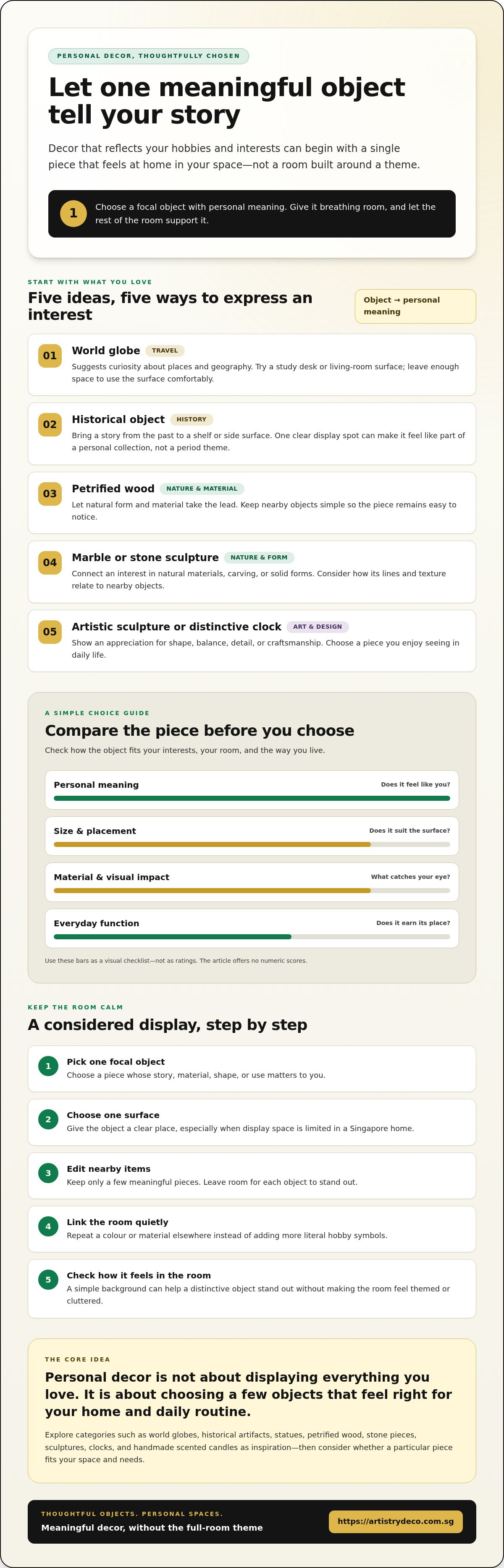
How to Display Personal Decor in a Singapore Home Without Clutter
A personal display should fit the way you use a room, not get in the way of it. Singapore homes vary in layout and available space, so choose a spot that works for your own routine, whether that’s a study desk, a living-room shelf, or a clear surface in a compact apartment.
Use this sequence to give decor that reflects your hobbies and interests a considered place:
- Choose the room. Think about where your interest naturally fits and where you’ll enjoy seeing the object.
- Select a focal surface. Pick a desk, shelf, or table with enough room for the piece and some space around it.
- Edit nearby objects. Move aside items that compete for attention. Add only a few pieces that support the display.
- Review the balance. Step back and check that the display feels settled and the room remains easy to use.
Where should a personal decor piece go?
Let your habits guide the placement. A globe or clock may suit a study or desk if you’ll look at or use it there. A sculpture or natural-material object can become a considered living-room focal point. Place a scented candle on a stable surface where it can be appreciated and used as intended. Keep everyday movement in mind: a display shouldn’t block a path, crowd a work area, or make a frequently used surface hard to reach.
How can you keep a display personal but uncluttered?
Begin with one meaningful object. Add another only if it helps tell the same story, perhaps through a related material, colour, or shape. Varying height or texture can add interest, but leave clear space around the focal piece so its form remains easy to see. A small group with room to breathe often feels more personal than a surface filled with loosely related accessories.
Before settling on an arrangement, check that each object sits securely and is visible from the places where you spend time in the room. For a scented candle, consider its intended use and choose a suitable location. Revisit the display if your interests change or the room needs to do something new. The aim is a thoughtful arrangement, not a permanent one.
Find Decor That Reflects Your Interests in Artistry Deco’s Curated Categories
Start with two questions: what interest would you like to express, and which room would feel right for it? A piece for a study may be chosen for how it fits your working habits, while an object for a living room might be selected for its visual presence. Artistry Deco Shop’s Singapore decor categories offer ideas to explore, but the right choice depends on your space, taste, and daily routine.
Which decor categories might suit your interests?
- Travel and geography: Explore world globes as a way to bring a lasting interest in places and maps into a study or shared room.
- Natural forms: Petrified wood decor and stone sculptures may appeal if you enjoy natural materials, geology, or sculptural shapes. Browse the petrified wood decor category as one starting point.
- Visual art: Sculptures can express an appreciation for form and detail without depicting a specific subject. A distinctive clock or handmade scented candle can also bring an artistic note to a room while fitting into your routine.
If you’re considering how an artistic object might work in a living room, look for functional living-room decor that suits the surface and the way you use the space. The aim is not to fill a room with objects, but to find a piece that connects your interest with its setting.
What should you check before making a choice?
Before choosing decor that reflects your hobbies and interests, review the product page for confirmed details on dimensions, material, intended use, and current availability. Then picture the piece in the room: will its colour sit comfortably with nearby surfaces, and will its size leave enough space for everyday activities? Consider where it will go and whether you’ll enjoy seeing it as part of your routine.
A category is a useful place to begin, not a promise that every object will suit every home. Compare the piece with your space and the interest you want it to express. If you have a question about Artistry Deco Shop’s stated decor categories, contact the store for more information.
Choose a Piece That Feels Like You
The most personal home doesn’t need a full hobby theme. A single well-chosen object can carry a story, reflect an interest, and sit comfortably within the room. As you choose decor that reflects your hobbies and interests, consider what feels meaningful, how the piece will fit your space, and whether it suits the way you use that room.
Artistry Deco serves customers in Singapore, with stated decor categories that include globes, sculptures, clocks, historical artifacts, and natural-material decor. Use these as starting points, then check each piece’s details and decide whether its form and function feel right for your home. Thoughtful placement and a little breathing room can help the object stand out without adding clutter.
Your home can tell your story in a quiet, considered way. Start with the interest you’d most like to bring into view, and let the right piece earn its place.
Frequently Asked Questions
How can I decorate my home to reflect my hobbies and interests?
Choose one or two objects connected to an interest you enjoy, then place them where they fit naturally into daily life. A globe might suit a study, while a sculpture could bring an artistic detail to a living room. Decor that reflects your hobbies and interests doesn’t need to be a literal symbol. A piece’s material, form, or story can make the link feel personal and considered.
How do I make hobby decor look elegant rather than themed?
Keep the display focused and let the object’s design do the work. Choose one main piece, or a small group with a clear link, instead of filling a room with matching hobby symbols. A natural material, familiar colour, or sculptural shape can suggest an interest in a subtle way. Leave space around the display and consider how it relates to the room’s existing colours and surfaces.
What decor should I choose if I love travel?
A world globe can bring an interest in travel or geography into a study, desk area, or living room. It may recall places you’ve visited or prompt curiosity about somewhere new. Choose a spot where the globe is easy to see and doesn’t crowd the surface. Artistry Deco offers world globes for study and work desks in Singapore, though the right choice depends on your room and preferences.
Can functional decor reflect a hobby or personal interest?
Yes. A useful object can express an interest while serving a role in your home. A globe can connect to travel and geography, while a distinctive clock may appeal to someone who enjoys design and timekeeping. Functional decor can suit rooms you use every day, so consider whether the object’s purpose and placement work with your routine as well as its appearance.
How many statement decor pieces should I display in one room?
There’s no fixed number, but starting with one statement piece can help you judge the room’s balance. Give it space, then add another object only if it supports the display without competing for attention. In a smaller room or on a compact surface, fewer pieces may keep the area feeling clear. Step back and check whether the objects are still easy to notice.
How can I display personal decor in a small Singapore home?
Choose a surface that suits the object and your routine, such as a desk, shelf, or living-room table, then edit nearby items to leave clear space around it. Check that the piece is stable, visible, and easy to live around. Singapore homes vary in layout, so use the available surface that works best for your own space rather than following a fixed room plan.
What is a thoughtful decor gift for someone with a specific hobby?
Choose a gift that reflects the person’s interest and suits their home, rather than relying on the most obvious hobby symbol. For someone drawn to travel, a globe may be worth considering. A sculpture could suit an art enthusiast, while a distinctive clock may appeal to someone who enjoys design. If you’re unsure, consider the recipient’s taste, available space, and how they might use the object.