
Conversation-Starting Objects for Your Living Room: Pieces with Stories to Tell

What if the object that makes your living room memorable is also the one that gives a guest an easy question to ask? The best conversation-starting objects for your living room do more than fill an empty surface. They bring a story, an unusual detail, or a useful role into the room, making your home feel more personal than a collection of generic decor.
Choosing a distinctive piece can be difficult when it looks beautiful but seems hard to place or use. Balance its story with its function, size, and style. A world globe, playful clock, sculpture, or scented candle can each add character in a different way.
This guide compares object types by their materials, purpose, and visual impact, then shares practical placement tips for a Singapore living room. Whether you want a quiet focal point or an item that fits into everyday life, start with a piece that feels at home in your space.
Key Takeaways
- Choose conversation-starting objects for your living room for their personal meaning, visual character, and role in everyday life.
- Globes, sculptures, distinctive clocks, scented candles, and sculptural vases can each invite a different kind of question.
- Compare an object’s story, function, visual fit, and size before choosing a place for it.
- Find a natural gathering area, select a visible surface, and check how the object looks from different spots in your Singapore home.
- Start with a theme that matters to you, then choose an object that suits both the room and your routine.
What Makes Conversation-Starting Objects for Your Living Room Memorable?
A conversation-starting object is a memorable piece that invites a natural question, observation, or story. It doesn’t need to be rare or dramatic. A personal connection, unusual shape, or useful purpose can give guests an easy opening to talk about what they notice.
The phrase has an artistic past: the history of the conversation piece refers to a genre of painting that showed people gathered in informal scenes. Today, the idea carries into the home. An object can create a point of connection, but it doesn’t need to make every guest comment.
How a decor object gives guests an easy opening
A guest might notice a globe on a side table and ask about a place marked on it. That can lead to a story about a trip, a family connection, or simply why you enjoy the object. A visible detail gives the exchange somewhere to begin, and the conversation can stay light or grow naturally.
A good conversation piece doesn’t require you to prepare a speech about your decor. It makes room for curiosity without asking the host to perform. Some guests may notice it and others may not; both responses are natural.
Story, function, and visual presence
A meaningful story adds depth beyond appearance. It might connect to a memory, place, or reason you chose the piece. The story can be simple: a globe might remind you of somewhere you hope to visit, while a sculpture may appeal to you for its shape or material. An elaborate history isn’t needed for an object to feel personal.
Everyday function can help decor feel at home, too. A clock has a clear role while adding visual interest, and a scented candle can be part of a quiet evening routine. Choose what suits your habits. A globe from the world globe collection, for example, might prompt a guest to ask about its shape or a place they recognise.
Visual presence matters, but attention alone isn’t the goal. Consider how the object’s shape and material relate to nearby decor, and whether people can see it without the piece crowding the room. A distinctive object should feel like it belongs, not as if it was added only to provoke a reaction.
That’s what separates thoughtful conversation-starting objects for your living room from novelty decor. Novelty may catch the eye for a moment; a considered piece also connects to your taste, fits into daily life, or holds meaning you’re glad to share. Its story can unfold at the pace of the room.
Five Conversation-Starting Objects for Your Living Room, Compared
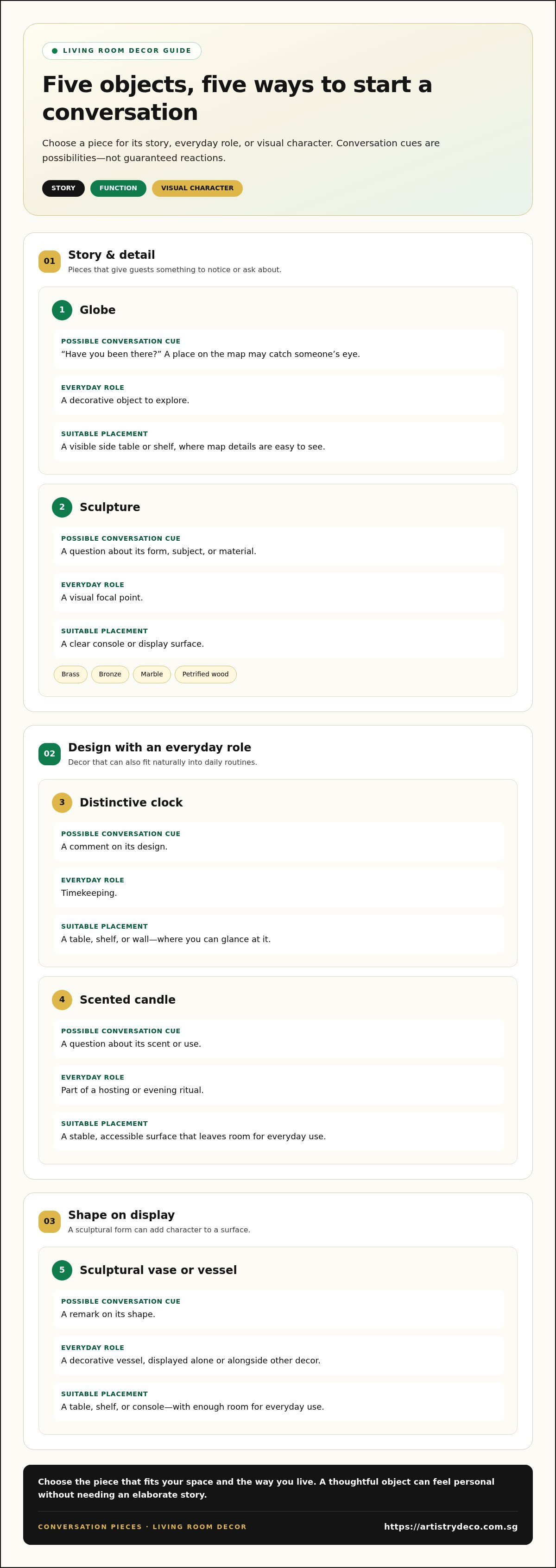
The right conversation piece depends on what you want it to bring to the room: visual interest, a practical role, or a personal story. These five categories offer different ways to make conversation-starting objects for your living room feel connected to daily life. The cues below are possibilities, not guaranteed reactions.
Globes and sculptures with a story to explore
A globe’s maps can draw the eye to a place a guest knows or hopes to visit. Its form may also prompt a question about why you chose it. Explore decorative world globes for a living room surface where the map details are easy to see.
Sculptures invite a different kind of looking. A guest might ask about the shape, subject, or material, such as brass, bronze, marble, or petrified wood. Your answer can be as simple as what drew you to the piece. Research on what your stuff says about you offers a useful lens: objects in a home can reflect personal taste and meaning.
Clocks, candles, and sculptural vessels
A distinctive clock pairs an everyday purpose with a design worth noticing. Scented candles can be part of a hosting ritual, while a sculptural vase or vessel adds shape to a shelf or table, displayed alone or alongside other decor. When viewing designer vases and candle holders, consider the surface you have in mind and whether the object will leave enough room for everyday use.
| Category | Possible conversation cue | Everyday role | Suitable placement |
|---|---|---|---|
| Globe | “Have you been there?” | Decorative object to explore | Visible side table or shelf |
| Sculpture | A question about its form or material | Visual focal point | Clear console or display surface |
| Distinctive clock | A comment on its design | Timekeeping | Table, shelf, or wall |
| Scented candle | A question about its scent or use | Part of a hosting or evening ritual | Stable, accessible surface |
| Sculptural vase | A remark on its shape | Decorative vessel | Table, shelf, or console |
Use the table as a starting point, then match the object to the way you live. A globe or sculpture may suit a spot where guests naturally pause; a clock may work best where you can glance at it; and a candle or vase can sit where it won’t crowd the surface. Artistry Deco Shop’s collection includes functional living room decor, globes, sculptures, and distinctive clocks. You can get in touch with Artistry Deco Shop while exploring ideas for your space.
How to Compare Conversation Pieces by Story, Function, and Style
A striking object is only a good fit if you enjoy living with it. Compare conversation-starting objects for your living room by weighing four things: story, function, visual fit, and size. The best choice doesn’t have to score equally on all four. It should feel right for your home and the way you use it.
- Story: What genuinely interests you about the object? A memory, place, subject, or design detail can be enough. You don’t need to invent an elaborate history. As secret histories of everyday objects suggests, even familiar forms can have stories worth exploring.
- Function: Will you use it, or do you value it mainly for its appearance? Both are valid. A clock has a practical role, while a sculpture can offer a visual focus without needing to do anything else.
- Visual fit: Notice the object’s shape, material, and character beside the room’s existing pieces. It can stand out without clashing or competing with everything around it.
- Scale: Picture it on the surface or in the area you have in mind. Does it suit the available space and remain visible from where people sit or gather?
Does the object have a story worth sharing?
Choose a piece you’re curious about yourself. Perhaps you’re drawn to a sculpture’s form, a globe’s details, or the way an object recalls a place or interest. That genuine response gives you something honest to say if a guest asks. Even without a long history, a shape, subject, or feature can prompt curiosity.
Will it suit your room and everyday life?
A functional piece can earn its place through repeated use as well as appearance. A sculpture may offer more freedom as a focal point, but it needs a spot where its form can be seen. Neither is the universal winner. In a Singapore home, consider the actual surfaces and sightlines available instead of assuming a particular room layout. One clear focal object often feels more considered than several pieces competing for attention.
| Priority | Object type to consider | Trade-off |
|---|---|---|
| Practical use with visual interest | Distinctive clock | Its placement should keep it easy to see. |
| A subject or form to explore | Globe or sculpture | It needs enough open space to stand out. |
| A decorative touch connected to a ritual | Scented candle or sculptural vessel | Its appeal may depend more on display or use than on a long story. |
Use these comparisons to narrow your choice, not to follow a fixed formula. A personal connection, useful role, and considered fit with the room can make a piece meaningful without asking it to do everything at once.
Where to Place Conversation-Starting Objects in a Singapore Living Room
Good placement lets an object be noticed without making the room feel arranged around it. Singapore homes have different layouts and available surfaces, so start with how people use your living room rather than assuming a particular floor plan. Follow three steps: find a natural gathering area, choose a visible surface, then test the view.
Choose a spot guests can notice naturally
Think about where guests sit, pause, or gather when they enter. A coffee table can bring an object into view during conversation, while a shelf or console may work if it can be seen from the seating area. Keep everyday use in mind: decor shouldn’t take over space you need for drinks, books, or other items.
Before settling on a spot, place the object there and look from seated and standing positions. Can you see its main details? Does it catch the eye without blocking a path or interrupting the way people face one another? Try another surface or turn the object slightly, then check the view again.
Create a focal point without creating clutter
Give one distinctive piece enough room to hold attention. When a sculpture or globe is surrounded by many other objects, its form and details can be harder to notice. Leave open surface around it, then add a few supporting items only if they share a visual link, such as a similar material, shape, or tone.
This works across different living room sizes and styles. On a coffee table, keep the arrangement low and useful for people gathered around it. On a shelf or console, use spacing to separate the focal object from nearby decor. You don’t need to make every surface a display. One clear point of interest often feels calmer and more personal than several pieces competing for attention.
Check the arrangement as part of daily life, not just from one carefully chosen angle. Walk through the room, sit where guests might sit, and see whether the object stays visible without getting in the way. If the room feels crowded, remove a supporting item or try a different location. Explore our home decor accessories for more ideas on combining useful decor with visual character.
Curate a Living Room Conversation Piece That Feels Like Yours
A memorable piece doesn’t need to dominate the room or come with a grand story. It should connect with your interests and feel comfortable in your daily life. Use this simple process to choose a focal object that suits your living room.
A simple way to make your shortlist
- Choose a personal theme. Start with a subject, material, place, or memory that matters to you. It might be a love of travel, an interest in sculpture, or an appreciation for natural materials. A genuine point of interest is a stronger starting place than a story invented to make an object seem special.
- Shortlist a few object categories. Compare two or three options, such as a globe, sculpture, or distinctive clock. Ask what attracts you to each, whether it has a role in daily life, and what detail you might enjoy sharing. Artistry Deco Shop’s brass sculptures for the home are one option if sculptural form and material are part of your theme.
- Picture each piece in place. Imagine the object on a shelf, console, or another surface you use. Consider its size, how it relates to nearby decor, and whether you can see its details from where people sit. Choose something that suits the room as it is, not only something that looks appealing on its own.
From considered choice to a more personal room
As you compare, consider how the four qualities work together: story gives a piece personal meaning, function connects it to daily life, size helps it feel proportionate, and visual fit lets it belong in the room. One object may be useful and striking; another may matter mainly for its shape. Either can be right if it reflects your taste and suits the space.
Artistry Deco Shop’s range includes sculptures, world globes, distinctive clocks, and other functional decor. Treat these as options to explore, not a checklist to complete. In a Singapore living room, the right choice fits the available space and feels natural in your routine, whether it becomes a quiet focal point or a useful part of the room.
Take your time with the shortlist. For ideas as you consider a decor choice, visit Artistry Deco Shop’s contact page.
Choose a Piece That Makes Your Living Room More Personal
The most memorable conversation-starting objects for your living room bring together a story you enjoy, a role that suits daily life, and a visual presence that fits the space. A piece doesn’t need an elaborate history or bold design to invite curiosity. A meaningful detail and thoughtful placement can be enough.
Start with a subject or material that feels personal, compare a few object types, then picture each one in your room. Sculptures, world globes, distinctive clocks, and scented candles offer different ways to add character. Artistry Deco Shop’s decor also includes brass, bronze, marble, and petrified wood pieces, giving you different materials and forms to consider.
Take your time and trust the object you can imagine living with. The right piece can feel at home every day and give guests a natural opening when they notice it.
A more personal living room can begin with one thoughtful object and the story you choose to share.
Frequently Asked Questions
What are conversation-starting objects for your living room?
They’re distinctive decor pieces that give guests something natural to notice, ask about, or share a thought on. A globe may invite a comment about its map, while a sculpture or clock can draw attention through its form or details. The best choice also suits the room and feels meaningful to the people who live there. In a Singapore home, consider how it fits the available space and your everyday routines.
Which living room objects are most likely to start a conversation?
Globes, artistic sculptures, distinctive clocks, scented candles, and sculptural vases can all offer guests a natural opening. A globe may bring up places or travel, while a clock or sculpture could prompt a comment about its design. No object guarantees a reaction, and there’s no single best choice for every home. Pick a category that reflects your interests, fits your living room, and feels right for everyday life.
How do I choose a conversation piece for my living room?
Start with what genuinely interests you, then consider the object’s story, function, visual fit, and size. Ask whether it has a natural place in the room and whether you’ll enjoy seeing or using it regularly. For example, a clock may combine timekeeping with visual character, while a sculpture can bring a distinctive form to a shelf or console. Choose for your home first, not only for the attention it might receive.
Can functional decor also be a conversation starter?
Yes. Functional decor can be useful and visually engaging at the same time. A distinctive clock, for instance, serves an everyday purpose while its design may invite a guest’s comment. World globes and scented candles can also connect with daily interests or routines. These pieces often feel at home because they contribute to the way you use the living room as well as its look.
How should I display a conversation piece without making my living room feel cluttered?
Give the piece room to be seen, and avoid surrounding it with objects that compete for attention. A shelf, console, or coffee table may work if it suits the item and the way you use the surface. Keep movement and daily activities in mind, especially in a smaller Singapore living room. A few supporting objects can help create a considered arrangement, but let the main piece remain clear and easy to notice.
What makes an object feel personal rather than just decorative?
An object can feel personal when it connects with an interest, memory, material, or subject that matters to you. It doesn’t need a long history or dramatic backstory. You might simply enjoy a sculpture’s shape, a globe’s map details, or the design of a clock. If you like having it in your home and can naturally explain why you chose it, it’s more than a decorative fill-in.
Are conversation-starting objects suitable for smaller living rooms?
Yes, provided the object suits the available space and doesn’t get in the way of everyday use. Consider choosing one focal piece rather than several accents competing for attention. A visible shelf, console, or clear area of a coffee table may be enough, depending on your layout. Check how the object looks from seated and standing positions, and leave enough room for people to move comfortably around the living room.