
Artist's Proof vs. Limited Edition Sculpture: The 2026 Collector's Guide

The most valuable sculpture in a gallery isn't always the one with the lowest number on its base. You might feel a sense of hesitation when you see an "A/P" mark instead of a standard edition number. It's a common challenge for collectors who want to ensure their home gallery holds its worth, especially as the global art market is projected to grow by 3.1 percent in 2026. Mastering the distinction of an artist's proof vs. limited edition sculpture is the first step toward making a truly confident investment for your home.
We know that art world terminology can feel like an exclusive club. You deserve to understand exactly what you're buying without the fear of overpaying for a piece that lacks genuine rarity. Artistry Deco Shop is here to serve as your guide through these technical details. We'll show you how to verify authenticity and explain why certain editions command higher prices at auction. By the end of this guide, you'll have the expert knowledge needed to select a breathtaking piece for your living room that serves as both a visual centerpiece and a lasting asset.
Key Takeaways
- Learn the core differences between an artist's proof vs. limited edition sculpture to understand how rarity and mold quality impact total value.
- Discover why the lost-wax casting process makes the first pulls from a mold so special for collectors of brass bronze statues.
- Understand the pricing gap and why an Artist's Proof often commands a premium of 20 to 50 percent over standard numbered editions.
- Gain the skills to read sculpture markings like A/P or E.A. so you can verify the authenticity of your next art investment with total confidence.
- Find out how to select the perfect sculptural piece, from metal works to petrified wood, to enhance the beauty of your modern Singapore home.
Understanding the Distinction: What Is an Artist's Proof vs. Limited Edition?
Entering the world of high-end decor often brings you face-to-face with labels that feel like a secret language. If you've ever felt a bit of confusion about the value of an artist's proof vs. limited edition sculpture, you aren't alone. These terms define the rarity, history, and ultimately the prestige of the piece you choose to display in your home. At Artistry Deco Shop, we believe every collector should feel like a confident expert before they bring a new masterpiece into their living space. We don't just provide objects; we offer a gateway into the narrative of the artist's studio.
A limited edition (L/E) refers to a set of identical sculptures created from a single, high-quality mold. The artist decides on a specific total number, such as 50 or 100; once these are cast, the mold is retired or destroyed. This process guarantees that no more will ever be made, protecting the value for every owner by ensuring the market is never flooded with reprints. An Artist's Proof (A/P) serves a different role in the studio. These are the very first sculptures pulled from the mold. The artist uses them to verify that every texture, line, and subtle detail matches their original vision perfectly before the full run commences.
The term "épreuve d’artiste" is the French equivalent of an artist's proof. It carries a historical weight that suggests a closer connection to the creator's hand, often being the version the artist was most intimately involved with. Because these pieces are produced before the main edition begins, they're technically outside the numbered count. This adds a layer of exclusivity that many seasoned collectors in Singapore find irresistible. It's a way to own a piece of the creative process itself, marking the moment when the artist's vision first became physical.
The Core Characteristics of Limited Editions
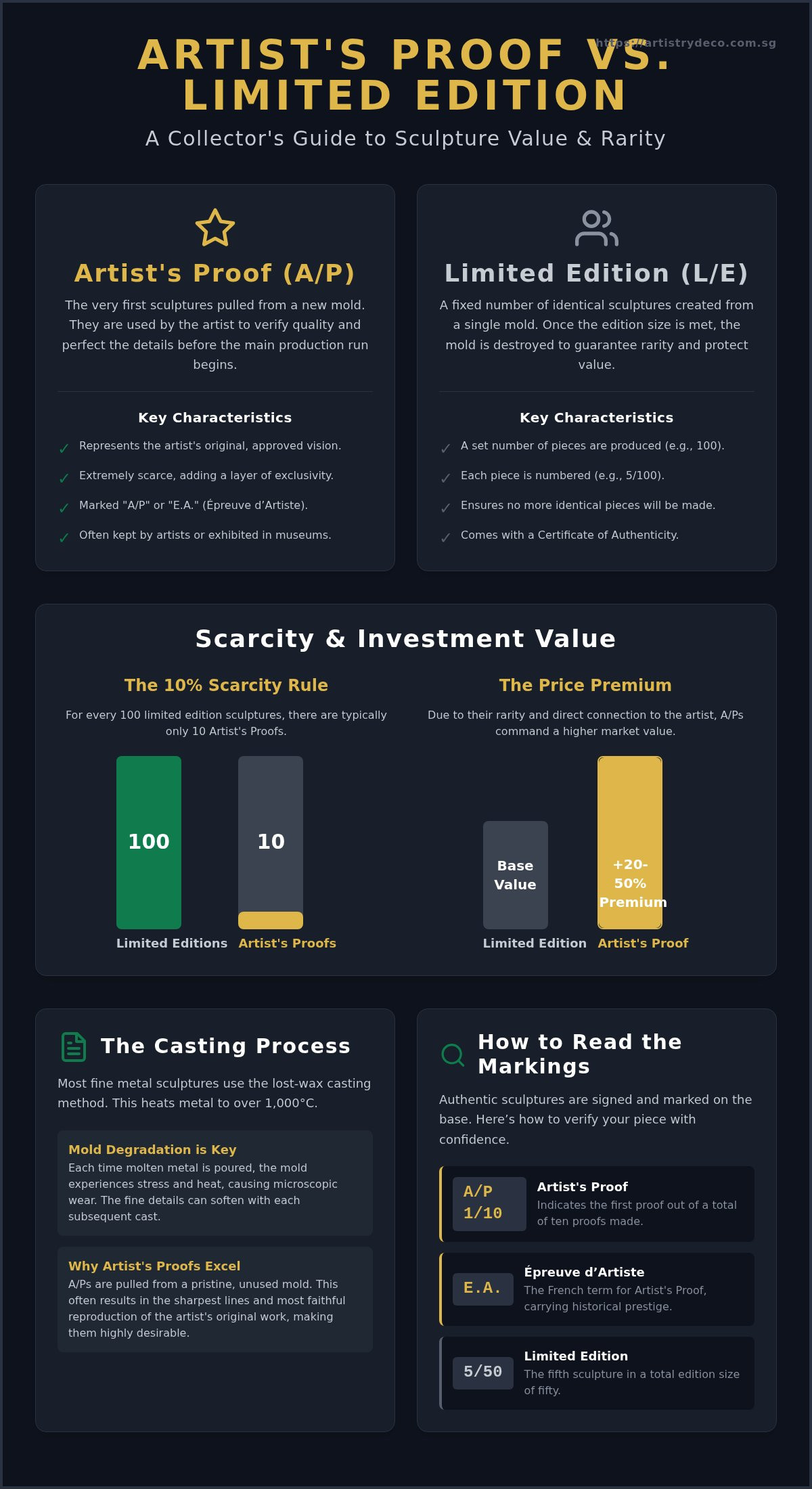
When you look at the base of modern artistic sculptures, you'll usually see a fraction like 5/50. This tells you exactly where that piece sits in the production run. While a lower number doesn't always mean higher quality, it provides a clear record of rarity that is essential for long-term value. Every legitimate limited edition should come with a signed certificate of authenticity. This document is your vital proof that the work is a genuine part of the artist's official output and not an unauthorized replica.
The Scarcity of the Artist's Proof
There's a general "10% rule" in the art world. If an edition is set at 100 pieces, the artist will typically only create 10 artist's proofs. This extreme scarcity is why they're so highly prized in the resale market. Many artists choose to keep these pieces for their personal archives or lend them to museums for prestigious exhibitions, further increasing their cultural value. Owning an A/P means you possess a sculpture that the artist personally inspected and approved before the rest of the world could see it. It's a powerful emotional connection to the artist's story that standard editions can't quite match.
The Genesis of a Masterpiece: How Sculptures Are Cast and Editioned
Understanding how a sculpture comes to life helps you appreciate the nuanced debate of an artist's proof vs. limited edition sculpture. Most fine metal works are born through the ancient lost-wax casting method. This labor-intensive process ensures that each piece captures the artist's touch, but it also places a heavy burden on the mold itself. The mold is the soul of the edition; it's the only bridge between the artist's original clay or wax creation and the final bronze or brass result. Without a perfect mold, the artist's vision can't be translated into a lasting medium.
From Liquid Metal to Fine Art
Creating brass bronze statues requires heating metal to over 1,000 degrees Celsius. In this molten state, the metal flows into a ceramic shell, taking the shape of the internal void. Achieving technical perfection in three dimensions is far more difficult than 2D printing because the metal shrinks as it cools. This physical change can cause tiny cracks or uneven surfaces that require expert hand-finishing. Once the metal sets, the artist applies a patina. This chemical finish gives the piece its final color and depth, often determining whether the work has good investment potential in the eyes of discerning collectors. A masterfully applied patina can highlight the tactile quality of the metal, turning a simple shape into a complex story of light and shadow.
Why the First Casts Matter Most
Every time a foundry uses a mold, the intense heat and physical pressure cause microscopic wear. The sharpest textures and finest lines are found in the very first pieces pulled from the new mold. These are the Artist's Proofs. By the time a foundry reaches the end of a limited edition run, the mold may have lost some of its initial crispness, resulting in slightly softer edges on the final few pieces. This degradation is a key factor when weighing the choice of an artist's proof vs. limited edition sculpture for your private gallery.
- A/Ps capture the freshest details directly from the artist's vision.
- Artists use these early casts to tweak the metal mix or cooling times before the main run begins.
- An A/P is the closest a collector can get to the artist's original clay model.
Owning an A/P means you're holding the purest possible version of the work, preserved in metal exactly as the artist intended. If you're looking for a specific piece to anchor your collection, we're happy to help you find something unique that fits your aesthetic vision.
Artist's Proof vs. Limited Edition: A Direct Comparison
Choosing between an artist's proof vs. limited edition sculpture often comes down to a balance of rarity, cost, and the desire for technical perfection. While both versions originate from the same creative spark, they occupy different tiers in a collector's portfolio. The limited edition provides a structured, predictable path to ownership. In contrast, the artist's proof offers a sense of proximity to the creator that few other items can match. It's a common myth that proofs are unfinished or rough drafts. In reality, these are often the most polished pieces in existence, as they serve as the artist's personal benchmark for the entire production run.
Beyond the standard editions, you might encounter 'Hors d'Commerce' (H/C) proofs. Translated as "outside of commerce," these pieces were historically never intended for public sale. They were often gifted to collaborators or kept by the foundry. Today, they occasionally enter the market, representing the absolute pinnacle of sculptural rarity. When you compare an H/C or an A/P to a standard edition, you're looking at a piece that wasn't just made to be sold; it was made to be a reference point for excellence.
Markings and Identification
Identifying your sculpture requires a keen eye for the inscriptions usually found near the base or on the underside of the work. A standard edition is marked with Arabic numerals, such as '1/100', indicating its specific place in the run. Artist's proofs are signed with 'A/P' or the French 'E.A.' (épreuve d’artiste). Sometimes, an artist might use Roman numerals (e.g., I/X) to distinguish a special subset of the edition from the main Arabic-numbered series. If you find a piece that claims to be part of an edition but lacks any visible numbering or signature, treat it as a red flag. Authentic artist's proof vs. limited edition sculpture markings are the "fingerprints" that secure your investment's future value.
Availability and Market Access
Finding a rare artist's proof usually requires a relationship with high-end galleries or specialized boutiques like Artistry Deco Shop. These pieces don't stay on the shelves for long. Standard limited editions are much more accessible and are a wonderful choice for those decorating a new BTO flat who want to blend artistic utility with a sophisticated aesthetic. While the primary market offers the thrill of being the first owner, the secondary market at auction houses often reveals the true staying power of a sold-out edition. Whether you're looking for a bronze centerpiece or a marble statement, understanding these market paths helps you build a collection that reflects both your taste and your foresight.
Investment and Rarity: Is an Artist's Proof Worth the Premium?
When you decide between an artist's proof vs. limited edition sculpture, you're making a choice about financial strategy as much as aesthetics. In the current market, an A/P typically carries a price premium of 20 to 50 percent over a standard limited edition piece. This isn't arbitrary. It reflects the extreme scarcity of the work and its closer historical tie to the artist's studio. Provenance, or the history of who has owned the piece, also plays a major role here. An A/P that was once part of the artist's personal collection or featured in a museum loan often appreciates faster on the secondary market than a standard numbered cast.
You might wonder why that extra investment is worth it if the visual difference to the naked eye is small. The answer lies in the intangible value. Much like a first edition book, the A/P holds a status that standard editions can't replicate. While the global art market shows steady growth, the most rare segments often prove to be the most resilient during economic shifts. Paying for the label is, in many ways, paying for the security of owning one of the few pieces the artist touched first.
The Psychology of the Collector
Owning an artist's proof places you in an inner circle of collectors. It's a feeling of exclusivity that resonates deeply with those who appreciate the narrative behind the work. Beyond the emotional connection, high rarity acts as a natural hedge against inflation. When you place an A/P at the center of your modern artistic sculpture collection, you aren't just decorating. You're preserving a specific moment in the artist's career that only a handful of people in the world can claim to own.
When to Choose a Limited Edition Instead
There are times when a limited edition is the smarter tactical move. If you're looking for high-quality decor for a corporate office or a large dining space, a standard numbered piece offers exceptional value. You can still find prestige within this category by seeking out early numbers. A piece marked 1/50 or 2/50 is often more desirable to future buyers than 49/50. This allows you to balance the joy of living with beautiful art and the practical side of investment potential. Whether you choose an artist's proof vs. limited edition sculpture, the key is to focus on pieces that speak to your personal taste first.
Elevating Your Singapore Home with Curated Sculptural Art
Bringing a museum-quality piece into your private residence is the final step in your collector's journey. Now that you understand the technical nuances of an artist's proof vs. limited edition sculpture, it's time to consider how these works interact with your specific living space. In a modern Singapore interior, a sculpture isn't just an object; it's a focal point that anchors the room's energy. The crisp details of an Artist's Proof deserve a setting that honors their rarity. This means thinking about lighting that catches every hand-finished edge and pedestals that provide the necessary breathing room for the art to shine.
The choice of material is equally vital for achieving a balanced aesthetic. You might lean toward the timeless, weighty presence of brass bronze statues, which offer a sense of historical permanence. Alternatively, you could contrast these man-made marvels with the organic, ancient allure of petrified wood sculptures. While a bronze piece represents the height of human craft, petrified wood is nature's own limited edition, with each grain telling a story millions of years old. Both materials embody the concept of functional art, turning a simple shelf or table into a curated gallery space.
Styling for Statement and Impact
Placement is everything when dealing with high-value artifacts. A bold sculpture makes an exquisite dining table centerpiece, sparking conversation during elegant social gatherings. For a more intimate feel, place a smaller work as a study desk accent where you can appreciate its tactile quality during quiet moments of work. It's essential to match the patina of your bronze pieces with your home's color palette; a deep, dark finish adds gravity to a minimalist room, while a golden hue brings warmth to stone surfaces. Remember that Singapore's tropical climate requires a bit of care. Keep your high-end sculptures away from direct air-conditioning vents and use a soft, dry microfiber cloth to maintain the surface without disturbing the artist's intended finish.
Starting Your Collection with Artistry Deco Shop
At Artistry Deco Shop, we act as more than just a boutique; we're your partners in discovery. We focus on the narrative behind every artifact, ensuring that the piece you choose has a soul and a history that resonates with your own. Whether you're looking for a one-of-a-kind stone carving or a numbered metal work, our curated selection prioritizes quality and rarity. We invite you to explore our full Modern Artistic Sculptures collection to find the next masterpiece for your home. Choosing between an artist's proof vs. limited edition sculpture is a personal decision, and we're here to ensure you make it with absolute confidence and joy.
Building a Legacy with Sculptural Art
Collecting fine art is a journey that blends passion with foresight. By mastering the nuances of an artist's proof vs. limited edition sculpture, you've gained the clarity needed to curate a home gallery with confidence. You now understand how rarity and historical provenance influence the long-term value of your investment. Each piece you choose is more than just decor; it's a testament to your appreciation for the artist's original vision and the intricate process of creation.
Artistry Deco Shop serves as your mentor in this world of high-end decor. Our collection features curated functional art made from premium materials like brass, bronze, and petrified wood. We combine our Singapore-based expertise with a passion for unique narratives to help you find masterpieces that elevate your modern interior. We believe that every artifact should tell a story that resonates with your personal aesthetic and lifestyle.
Let your living space reflect the sophistication you value most. We're here to guide you as you select the next timeless anchor for your home collection with joy and ease.
Frequently Asked Questions
Is an artist's proof more valuable than a limited edition sculpture?
Yes, an artist's proof usually holds higher market value because of its extreme rarity. Since they represent only about 10 percent of the total production, collectors often pay a premium for them. This price gap reflects the closer link to the artist's initial approval of the mold. While the visual quality is the same, the A/P status makes it a more sought-after asset for those building a high-end private collection.
How many artist's proofs are usually made for a sculpture?
Most artists follow a standard rule where artist's proofs account for 10 to 15 percent of the main edition size. If a foundry produces a limited run of 50 sculptures, you'll likely find only five proofs in existence. This small number ensures that the pieces remain exclusive and highly collectible. It's this strict limit that helps maintain the piece's status as a rare treasure compared to the standard numbered series.
Can I tell the difference between an A/P and a limited edition just by looking?
You won't find a visual difference in quality, as modern casting ensures all pieces are identical. The only way to distinguish an artist's proof vs. limited edition sculpture is by checking the markings on the base. A limited edition will show a fraction like 5/100, while a proof will be marked with A/P or E.A. These inscriptions are the primary way to identify the piece's specific place within the artist's production history.
What does 'E.A.' mean on a sculpture's base?
The letters "E.A." stand for Épreuve d’Artiste, which is simply the French term for an artist's proof. This marking carries a great deal of prestige in the international art market. It signals that the sculpture was one of the first successful pulls from the mold. Many global foundries use this French label to honor the historical traditions of bronze casting, adding an extra layer of elegance and heritage to the piece.
Are artist's proofs ever signed?
Yes, every authentic artist's proof should be signed by the artist. The signature is usually found near the A/P or E.A. marking on the base of the work. This personal touch serves as the artist's final seal of approval for the cast. A signature not only confirms the piece is a genuine creation but also adds significant emotional and financial value for any collector looking to secure a high-quality investment.
Is a limited edition of 100 considered rare in the sculpture world?
An edition of 100 is considered moderately rare, but rarity is relative to the artist's popularity. In the world of fine bronze or marble work, editions of 25 or 50 are often seen as more exclusive. However, for a high-demand artist, a run of 100 still offers a strong balance of accessibility and value. It's always best to check the total number produced to understand exactly where your piece sits in the market.
Do artist's proofs come with a certificate of authenticity?
Every legitimate artist's proof must come with a formal certificate of authenticity (COA). This document provides the essential paper trail that proves your sculpture is an official part of the artist's output. It should clearly state the edition size and confirm the piece's status as an A/P. Without this certificate, it's difficult to verify the work's history, which can negatively impact its resale value in the future.
Why are some sculptures marked 'H.C.' instead of 'A/P'?
Sculptures marked "H.C." stand for Hors d’Commerce, meaning they were originally created for exhibition or as gifts rather than for public sale. These pieces are even rarer than standard artist's proofs. While they occasionally enter the secondary market, they were historically reserved for the artist's inner circle or museum partners. Owning an H.C. piece is often considered the ultimate achievement for a dedicated collector due to its unique "not for sale" history.